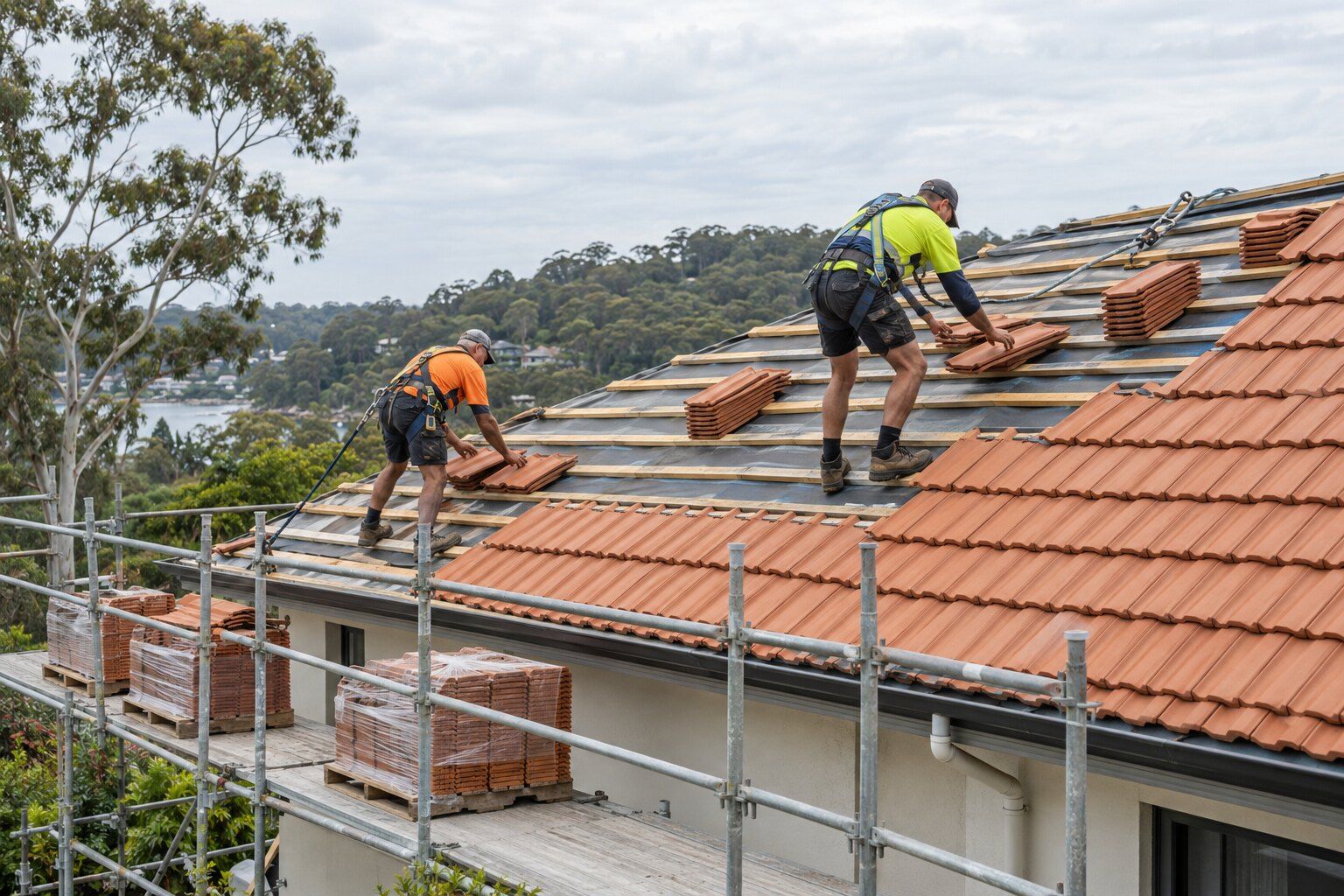
What a re-roof involves
Re-roofing replaces the roof covering itself: the tiles or sheets come off, and the roof goes back on new from the battens up. The frame underneath usually stays. A typical re-roof runs in this order:
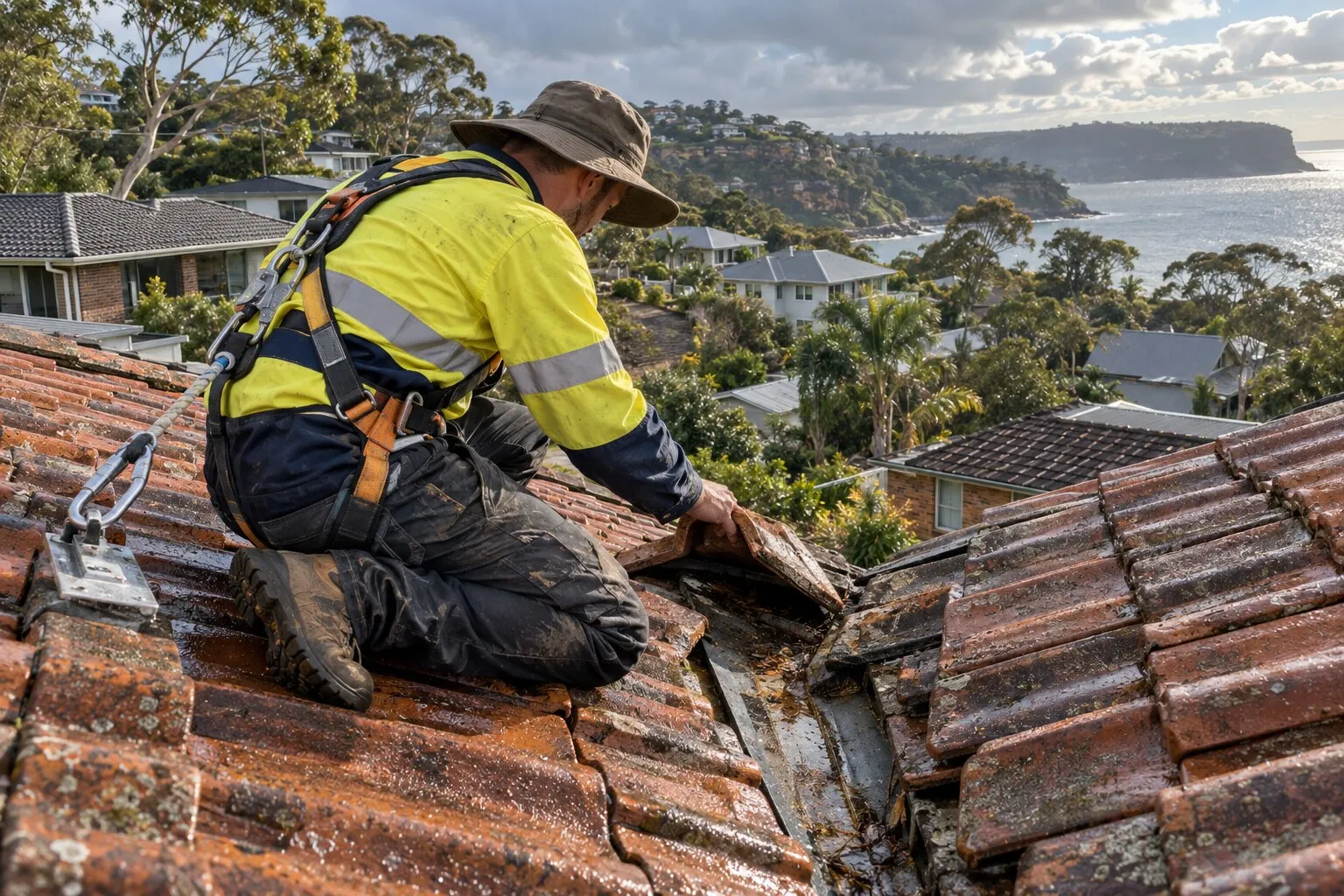
- Strip. The old tiles or sheets come off and go into a bin, and the roof is checked for rotten or damaged timbers.
- Sarking. A reflective membrane is laid over the rafters. It catches any water that gets past the tiles or sheets and carries it to the gutter.
- Battens. New or refixed battens, spaced to suit the tiles or steel going on.
- Roof covering. The new sheets are screwed down, or the tiles laid and fixed.
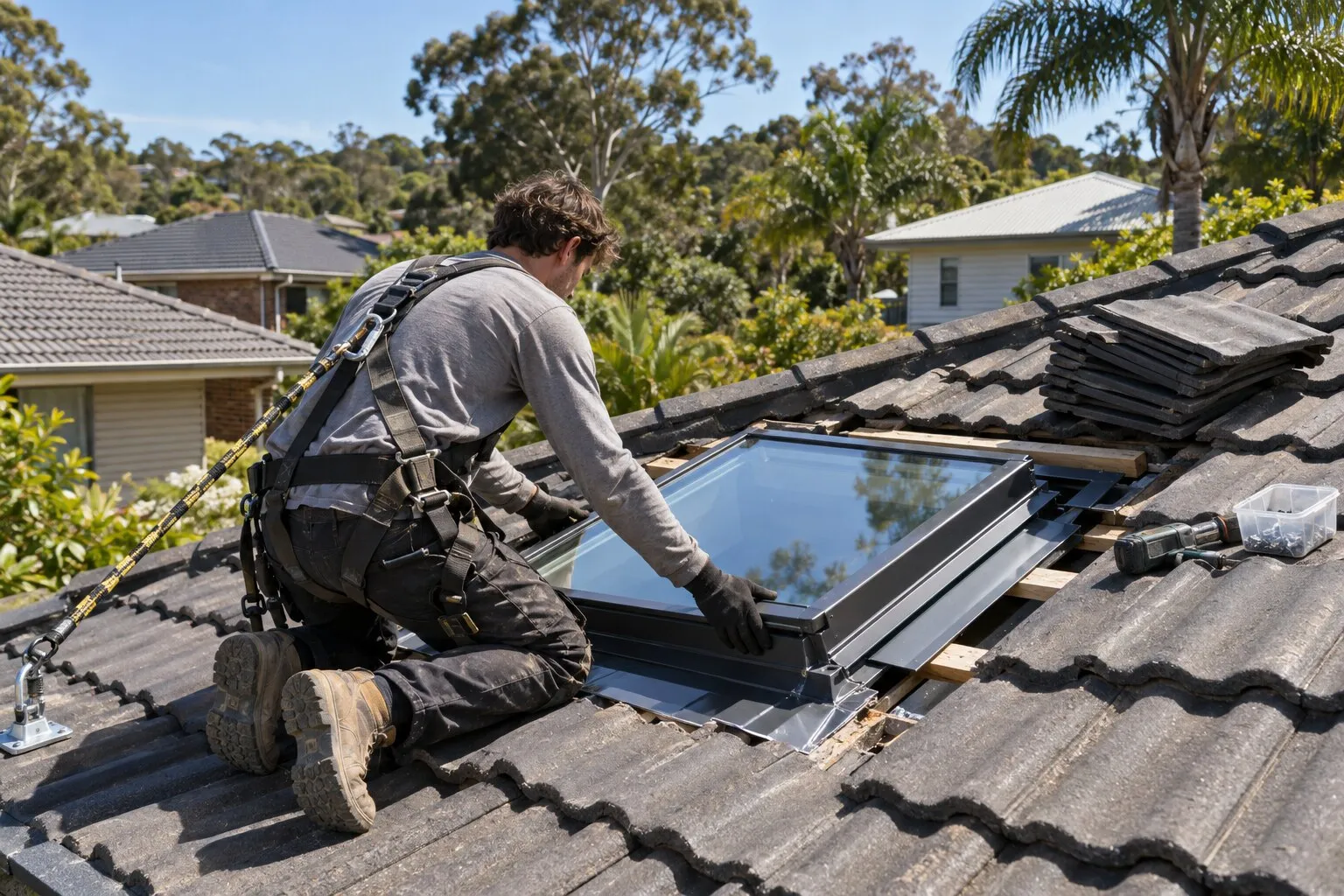
- Flashings, ridges and valleys. New flashings where the roof meets walls, chimneys, skylights and vents, then the ridge capping and valleys.
One Sydney contractor whose rates appear below says its price includes “stripping the old roof, new sarking and standard flashings”. When you compare quotes, check each one says the same.
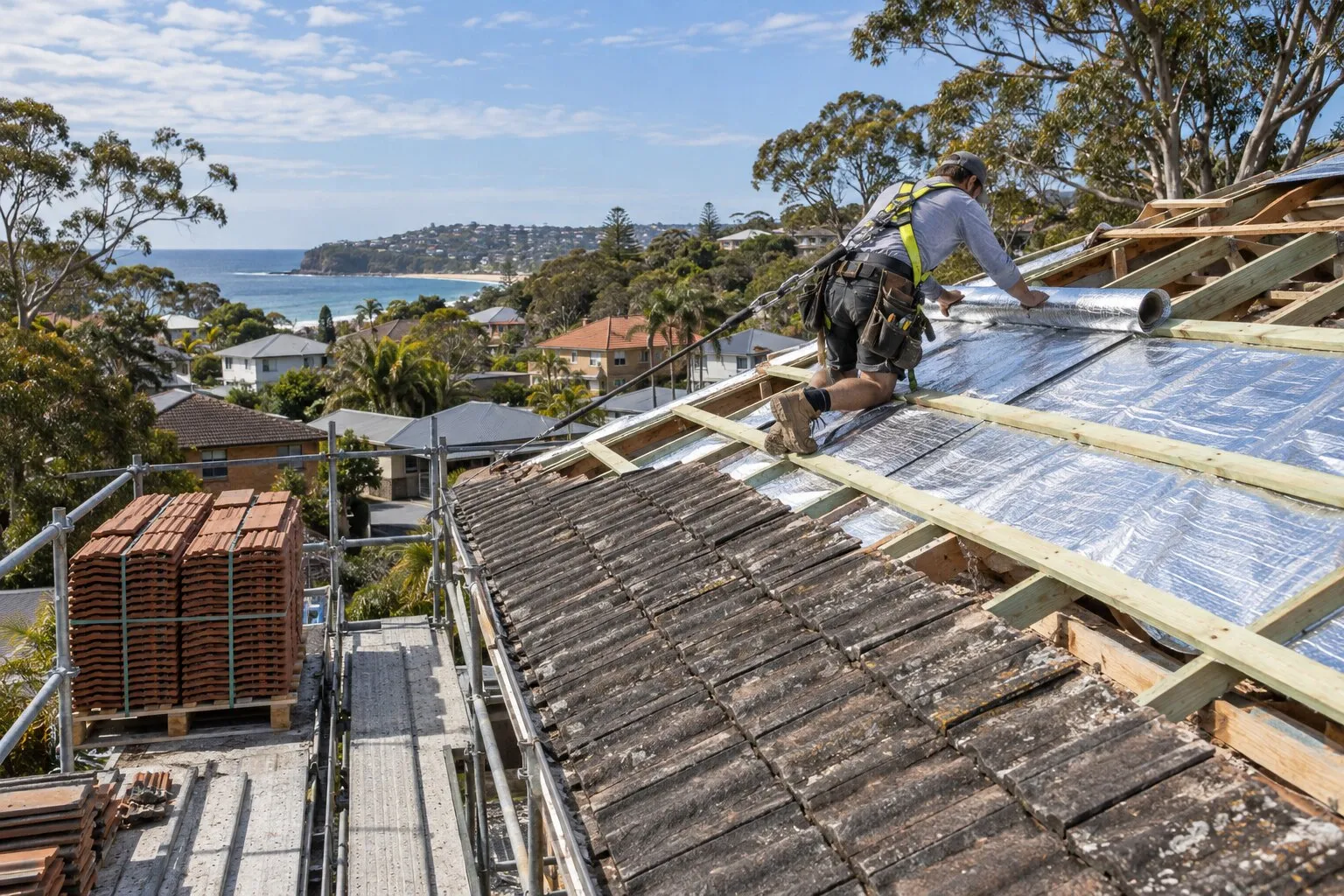
Concrete tile to Colorbond
Swapping a tired concrete tile roof for Colorbond takes a lot of weight off the house, because steel is far lighter than tile. The battens change to suit the steel, and the frame and fixings need to be right for the new roof, so ask the roofer how they’ll check them. In NSW, metal roofing is roof plumbing work, so it needs a roof plumbing licence.
Old corrugated iron to new steel
A rusted iron roof on an older cottage can be replaced with new corrugated Colorbond or Zincalume, in much the same profile. Ask whether the quote replaces the gutters, flashings and screws as well, or reuses them.
Terracotta: re-laid or new
Where most of the tiles on a terracotta roof are sound, a roofer can lift them, fit new sarking and battens, and re-lay them with matching replacements for the broken ones. Where they’re crumbling, new tiles go on. Tile maker Monier says all its concrete and terracotta tiles “are salt safe and will not corrode over time”. It makes tiles, so read that alongside the steel makers’ guidance below.
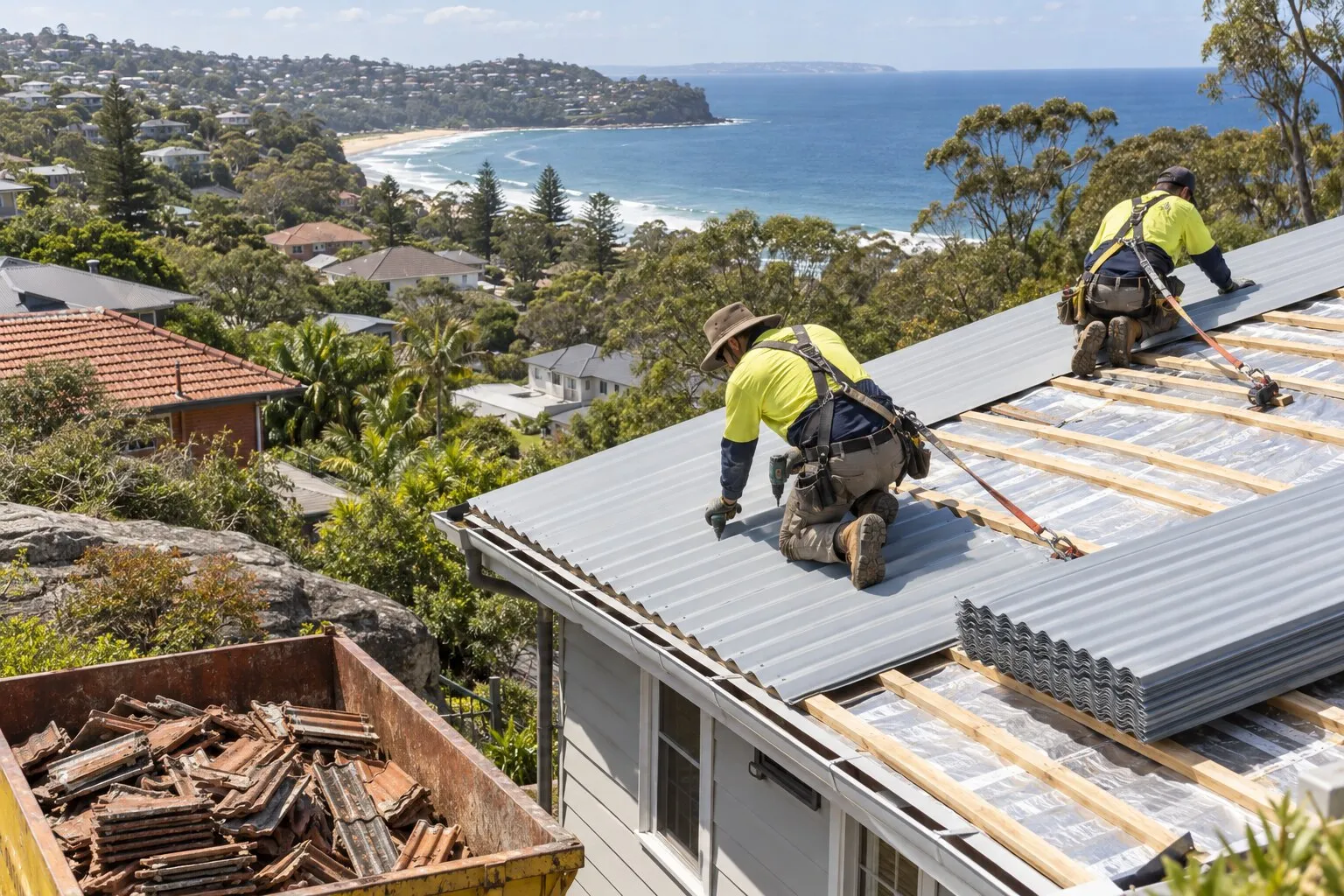
Choosing steel near the surf
Near the beach, the grade of steel matters. BlueScope’s selection guide (TB-1A, March 2023) recommends:
- Colorbond in a Classic or Matt finish more than 200 m from breaking surf or exposed marine conditions
- Colorbond Ultra more than 100 m from breaking surf
- Superdura stainless steel closer than that
Distances are measured from the high-water mark, and BlueScope calls the table a guide only, subject to local conditions such as prevailing winds. The screws matter too: Lysaght’s fastener bulletin calls for AS 3566.1 Class 4 screws in severe exposure conditions. Our guide to Colorbond, Ultra or Zincalume near the coast has the full table and the washing BlueScope recommends, and the coastal roof material finder applies BlueScope’s tables to your own distance from the water.
Colorbond colours for a new roof
BlueScope’s colour chart lists 22 Colorbond colours for roofing. Seven of them also come in Colorbond Ultra, which BlueScope’s guide recommends more than 100 m from breaking surf, where standard Colorbond needs more than 200 m. So a Colorbond roof between 100 and 200 m from the surf comes in those seven colours. Six of the 22 also come in a Matt finish, in Colorbond steel rather than Ultra: Surfmist, Dune, Shale Grey, Bluegum, Basalt and Monument.
- Dover White
- SurfmistAlso in Ultra
- Southerly
- Shale GreyAlso in Ultra
- Bluegum
- WindsprayAlso in Ultra
- Basalt
- Classic Cream
- Paperbark
- Evening Haze
- DuneAlso in Ultra
- Gully
- Jasper
- Manor Red
- WallabyAlso in Ultra
- Woodland GreyAlso in Ultra
- Pale Eucalypt
- Cottage Green
- Ironstone
- Deep Ocean
- Night Sky
- MonumentAlso in Ultra
Lighter colours reflect more of the summer sun. Some parts of the Northern Beaches also have council controls on roof colour and reflectivity, so check those for your property before the colour is ordered.
Does a re-roof need council approval?
Often not, but it depends on the house, so don’t assume. NSW’s Codes SEPP makes “the repair to or replacement of a non-structural wall or roof cladding” exempt development (clause 2.53) “if it is not constructed or installed on or in a heritage item or a draft heritage item or in a heritage conservation area or a draft heritage conservation area”. Clause 2.54 adds standards. The work must:
- “not comprise the making of, or an alteration to the size of, any opening in a wall or roof, such as a doorway, window or skylight”
- “not reduce the existing fire resistance level of a wall or roof”
- on bush fire prone land, “be adequately sealed or protected to prevent the entry of embers” and “use equivalent or improved quality materials”
- for cladding, “not be carried out on any building other than a 1 or 2 storey dwelling house, attached development or detached development” and “not involve the use of external combustible cladding”
Exempt work must also meet the Building Code of Australia, and it can’t involve removing more than 10 m² of bonded asbestos, or any friable asbestos, unless a licensed asbestos removalist does the removal (clause 1.16). Those are the clauses as published in 2025; the SEPP is amended often.
- Heritage. Northern Beaches Council’s heritage FAQ says: “If you wish to repair, change or renovate your heritage-listed property you need to lodge a development application.” In a heritage conservation area the exempt route above doesn’t apply either. Your section 10.7 planning certificate, or council’s property search, shows whether either affects your home.
- Bush fire prone land. Check whether your block is on council’s bush fire prone land map. Council says the exempt standards “will tell you what materials you can use, usually non-combustible materials or hardwood”. The BAL roofing requirements checker summarises the NSW rules for each bushfire attack level.
- Everything else. Council says that when a project meets the standards, “approval from Council may not be needed”. Its planning line is 1300 434 434.
Changing from tile to steel isn’t excluded by the clause’s wording, but heritage, the building code and the roof frame can each take a job out of the exempt route. Ask the roofer to confirm the approval pathway for your house before you sign.
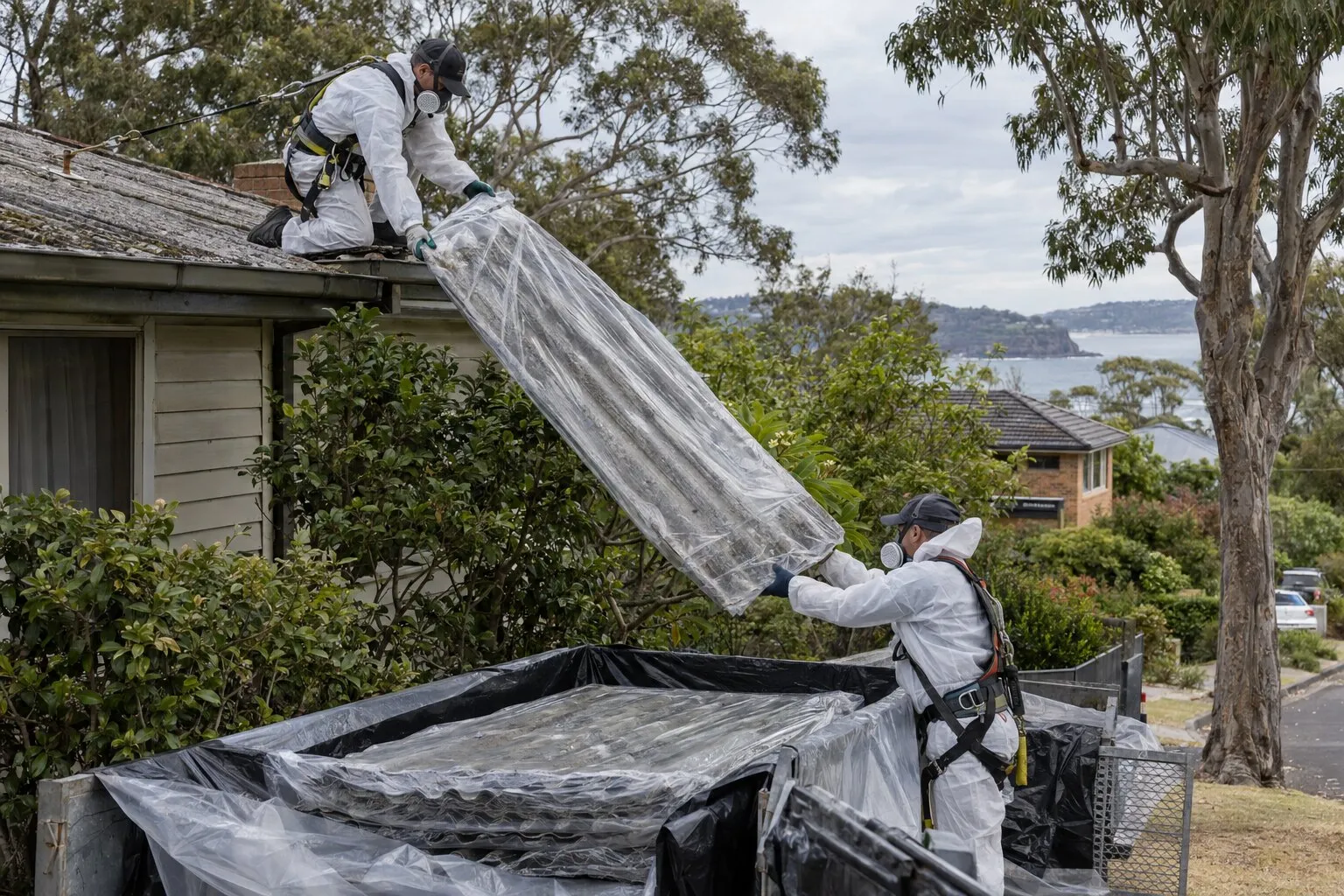
Asbestos cement roofs
The NSW EPA says: “If your house was built before 1990, it probably has asbestos-containing materials.” Northern Beaches Council puts it as homes “built or renovated before 1987”. Corrugated fibro roofs from that era may be asbestos cement.
SafeWork NSW says you “must always use a licensed asbestos professional” to remove more than 10 m² of non-friable (bonded) asbestos, and recommends one for any amount. A whole roof is well over 10 m², so the old sheets come off under a licensed removalist before the new roof goes on. SafeWork also says never to use high-pressure water on asbestos roofs, and that they “can be brittle, making them easy to fall through”. Ask for the removal as its own line on the quote.
Replace or restore?
A roof restoration suits a roof whose tiles or sheets are still sound: it cleans, repairs, repoints and recoats what’s there. Replacement makes more sense when concrete tiles are crumbling across whole sections, when Colorbond or iron is rusting through rather than just at the screws, or when the roof is asbestos cement. A roofer who has been up on the roof can tell you which yours is.
Roof replacement prices
Northern Beaches roofers rarely publish re-roofing prices, so these are published Sydney and national figures. The roofer prices your roof once they’ve measured it and looked at the access.
Published Sydney re-roofing rates
| What’s charged | Published price | Who publishes it |
|---|---|---|
| Colorbond and metal, per m² of roof | from $170 | Aussie Roof Repairs, Sydney (undated) |
| Concrete tile, per m² of roof | from $180 | Aussie Roof Repairs, Sydney (undated) |
| Terracotta tile, per m² of roof | from $200 | Aussie Roof Repairs, Sydney (undated) |
| Typical 200 m² single-storey roof in Colorbond | $37,500 to $45,000 | Aussie Roof Repairs, Sydney (undated) |
| Typical 200 m² single-storey roof in terracotta | $46,000 to $55,000 | Aussie Roof Repairs, Sydney (undated) |
One Sydney contractor’s published rates, checked 1 October 2026. The page is undated and doesn’t say whether GST is included. It says the rates include “stripping the old roof, new sarking and standard flashings”, and that two-storey access, a pitch over 30° and complex roofs cost extra. By our arithmetic its typical totals work out at $187.50 to $225 per m² for Colorbond ($37,500 ÷ 200 and $45,000 ÷ 200), above its own “from” rate.
Published per-job and national prices
| What’s charged | Published price | Who publishes it |
|---|---|---|
| Tile-to-Colorbond conversion or new Colorbond roof | $15,000 to $35,000 | Crown Roofers, Mona Vale page (undated) |
| Full new tile roof (concrete or terracotta) | $12,000 to $28,000 | Crown Roofers, Mona Vale page (undated) |
| Colorbond installed, per m² | $53 to $97 | hipages, national guide |
| Tile to Colorbond on an old-style roof | $15,000 to $20,000 | hipages, national guide |
Checked 1 October 2026; neither page says whether GST is included. The first two rows are a Sydney-wide contractor’s Mona Vale page, which is undated and uses the same wording as its pages for other suburbs. The last two are a national marketplace’s guides (20 and 6 January 2026). These bands sit well below the Sydney per-m² rates above; roof size, pitch, access and whether the old roof is asbestos explain much of the gap.
Two storeys, a steep pitch, a tricky block, asbestos removal or coastal-grade steel all add to these. The roof replacement cost guide explains the gap between the two tables, asbestos removal prices and the deposit rules.
Contracts, deposits and insurance
Every published re-roofing price we found is well over $5,000, and many are over $20,000, so these NSW rules apply:
- Over $5,000 including GST: a written contract showing the licence holder’s name and contractor licence number. Between $5,000 and $20,000 that’s a small works contract.
- Over $20,000 including GST: a full home building contract, and a cooling-off period of five clear business days after you’re given a copy.
- HBCF insurance over $20,000. icare says the roofer must have Home Building Compensation Fund cover before they “Start work, or take any payment for the project, including a deposit”.
- Deposit cap: “The maximum amount of a deposit for residential building work is 10% of the contract price.”
Who can do the work
NSW Fair Trading says you must hold a contractor licence to “carry out, advertise or contract for” building or trade work valued at more than $5,000 in labour and materials, including GST. For a re-roof, the category depends on the roof going on:
- Roof plumbing for Colorbond and other metal roofs, gutters, downpipes and flashings.
- Roof tiling for concrete and terracotta tiles, including bedding and pointing, valleys, sarking and battens.
- Roof slating for slate, shingles and shakes.
Asbestos removal is licensed separately, by SafeWork NSW. You can check any contractor licence on the Service NSW licence register.
What to have ready
- What the roof is now (concrete tile, terracotta, iron, Colorbond or fibro) and roughly how old the house is
- What you’d like instead, if you know, and roughly how far the house is from the surf
- Single or two storey, the house’s rough size, and how steep the block and driveway are
- Whether the property is heritage-listed or on bush fire prone land, from your planning certificate
- Photos of the roof from the ground, and any leaks or stains inside
Common questions
How much does a new roof cost on the Northern Beaches?
Northern Beaches roofers rarely publish it. A Sydney contractor publishes re-roofing from $170 per m² for Colorbond and from $200 per m² for terracotta, supplied and installed, and puts a typical 200 m² single-storey roof at $37,500 to $45,000 in Colorbond. A Sydney-wide contractor’s Mona Vale page publishes $15,000 to $35,000 for a tile-to-Colorbond conversion. Both pages are undated. See the roof replacement cost guide.
Do I need council approval to replace my roof?
Often not, but it depends on the house. Under NSW’s Codes SEPP, replacing roof cladding on a one or two storey house can be exempt development if the home isn’t a heritage item or in a heritage conservation area, no roof openings are added or resized, and, on bush fire prone land, the new roof is sealed against embers, among other conditions. Northern Beaches Council says heritage-listed properties need a development application. Ask the roofer to confirm the approval pathway for your house before you sign.
Should I use Colorbond Ultra near the beach?
BlueScope’s selection guide recommends standard Colorbond (Classic or Matt finish) only more than 200 metres from breaking surf, Colorbond Ultra more than 100 metres away, and Superdura stainless steel closer than that, measured from the high-water mark. It calls the table a guide only. See Colorbond, Ultra or Zincalume near the coast.
What if my old roof is asbestos cement?
In NSW, removing more than 10 m² of bonded asbestos needs a licensed asbestos removalist, and SafeWork NSW recommends one for any amount. A whole roof is well over 10 m². Never water-blast it or walk on it: SafeWork warns asbestos roofs can be brittle enough to fall through. Ask how the removal will be arranged and priced, as its own line on the quote.
Is home building insurance needed for a re-roof?
For residential building work over $20,000 including GST, the roofer must have Home Building Compensation Fund (HBCF) cover before they start work or take any payment, including a deposit. The deposit itself is capped at 10% of the contract price, and you have a five clear business day cooling-off period on contracts over $20,000.
Where these figures come from
The prices and rules on this page come from these published pages, checked on 1 October 2026.
- Aussie Roof Repairs: roof replacement Sydney · Sydney roofing contractor (Oatley), undated
- Crown Roofers: roof replacement Mona Vale · Sydney-wide roofing contractor, Mona Vale suburb page, undated
- hipages: how much does Colorbond roofing cost · National trades marketplace cost guide, updated 20 January 2026
- hipages: how much does roof replacement cost · National trades marketplace cost guide, updated 6 January 2026
- hipages: how much does roof restoration cost · National trades marketplace cost guide, updated 6 January 2026
- State Environmental Planning Policy (Exempt and Complying Development Codes) 2008, clauses 2.53 and 2.54 · NSW planning law: minor external building alterations, including roof cladding
- Northern Beaches Council: exempt and complying development · Local council guidance, undated
- Northern Beaches Council: FAQs about heritage · Local council guidance, undated
- BlueScope TB-1A: steel roofing products selection guide · Manufacturer technical bulletin, March 2023, revision 14
- NSW Government: guide to providing home building contracts · NSW Fair Trading guidance, updated 11 June 2026
- icare: do I need HBCF? · NSW Home Building Compensation Fund, undated page
- SafeWork NSW: asbestos · NSW work health and safety regulator, updated 14 August 2026
- hipages: how much does roof restoration cost · National trades marketplace cost guide, updated 6 January 2026
- Monier: FAQs · Roof tile manufacturer, page updated 22 September 2026
- Lysaght PAB04: fasteners · Manufacturer product advisory bulletin, January 2024
- Northern Beaches Council: bush fire prone land · Local council guidance; map certified 7 August 2020
- NSW EPA: dealing with household asbestos · NSW Environment Protection Authority, updated 22 November 2025
- Northern Beaches Council: asbestos · Local council guidance, undated
- SafeWork NSW: managing risks of exposure to asbestos · NSW work health and safety regulator, updated 30 June 2025
- Home Building Act 1989 (NSW), sections 7, 7AAA, 7BA and 8 · NSW legislation: written contracts, cooling-off and the 10% deposit cap
- NSW Government: roof tiling work licence · NSW Fair Trading licence page, updated 23 June 2026
- NSW Government: roof plumbing work licence · NSW Fair Trading licence page, updated 23 June 2026
- Service NSW: check a trade licence · NSW Government licence register
Related guides
- Colorbond, Colorbond Ultra or Zincalume near the coast?BlueScope’s distances from breaking surf, the screws that suit salt air, washing, and what that means for Beaches homes.
- Asbestos roofs on the Northern Beaches: removal and replacementTesting a fibro roof, SafeWork’s licence rules, Kimbriki disposal, clearance certificates and published removal prices.
- Roof sarking and whirlybirds for coastal homesWhat sarking does, when tiles need it, condensation under metal roofs, bush fire rules and which whirlybirds suit the coast.