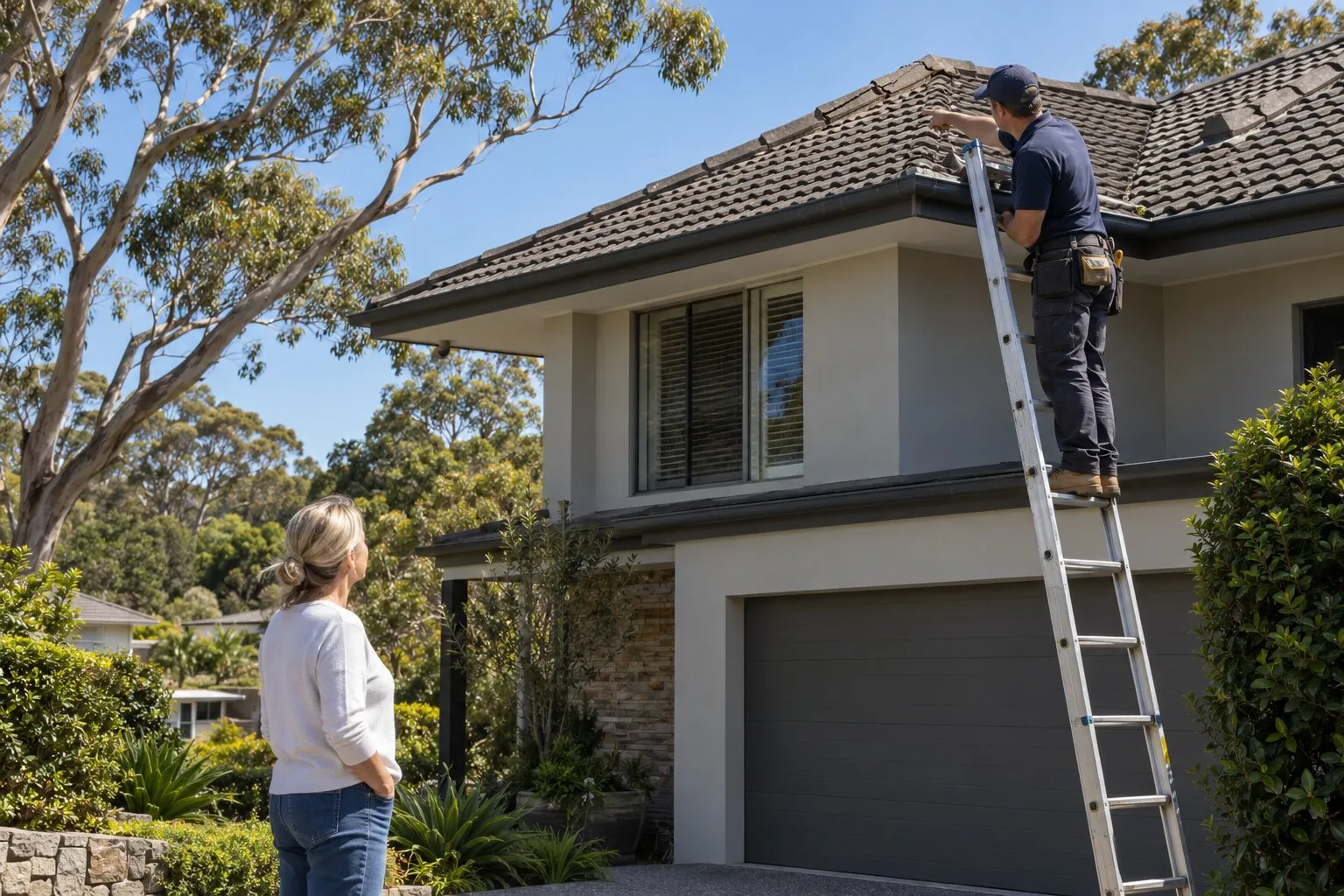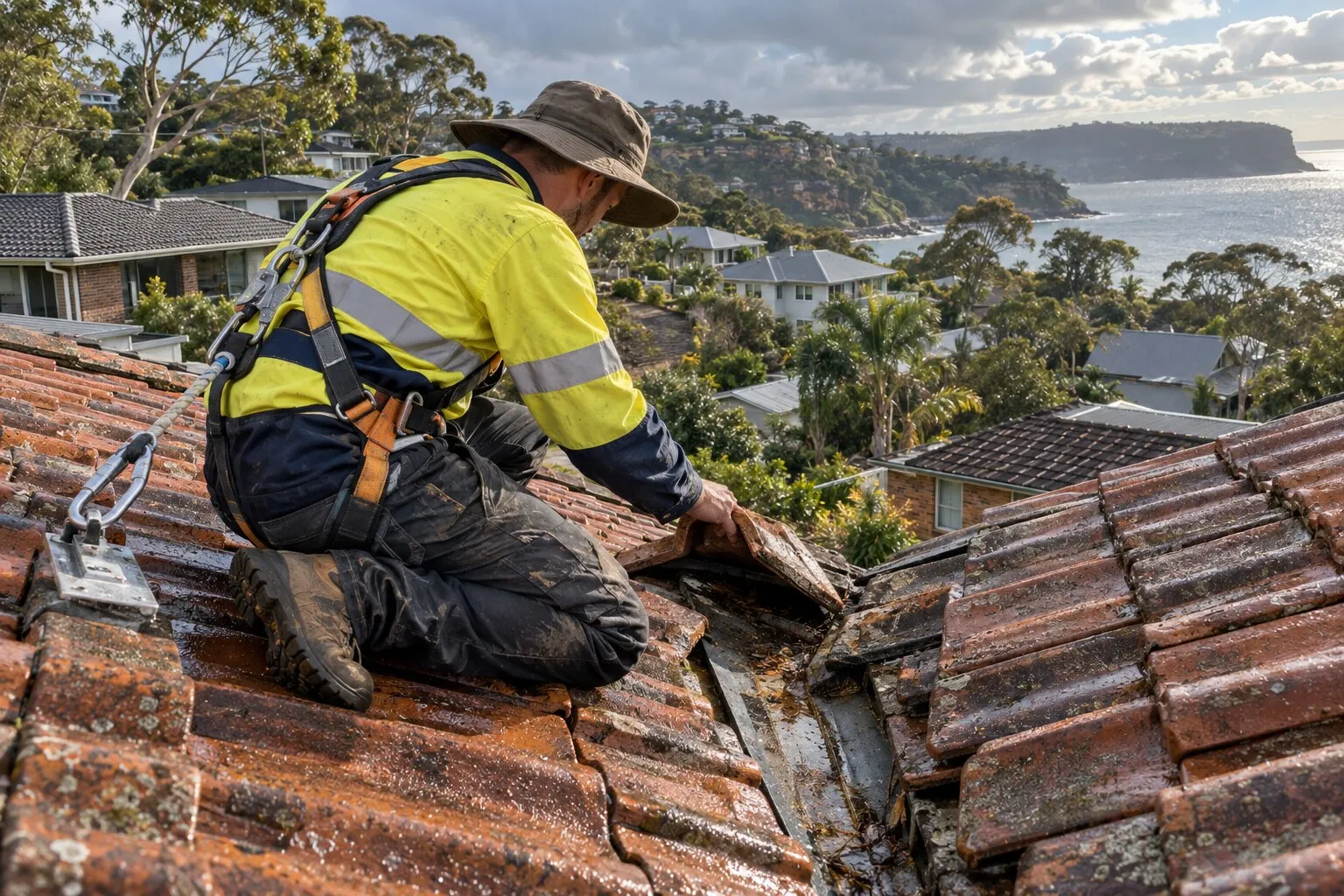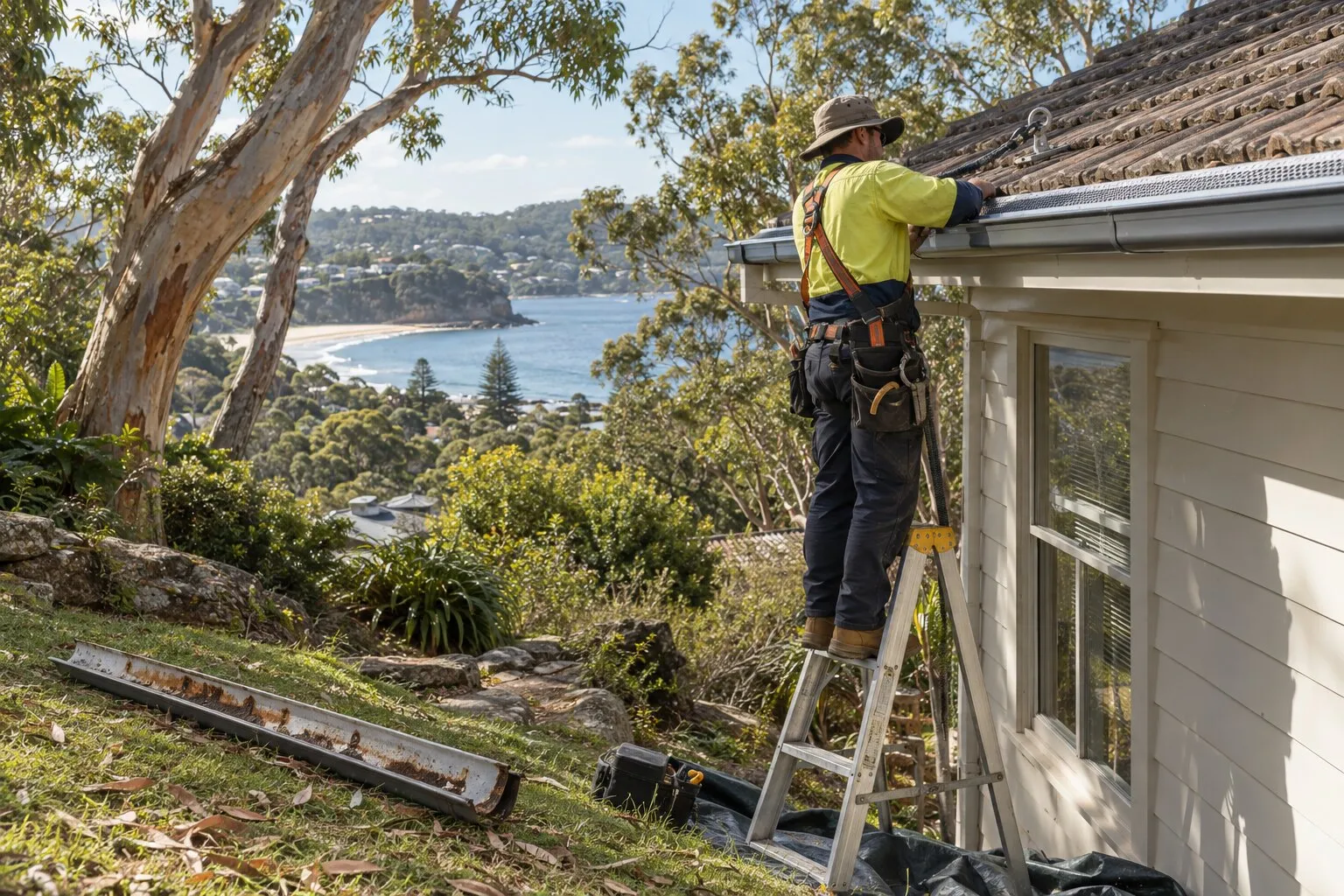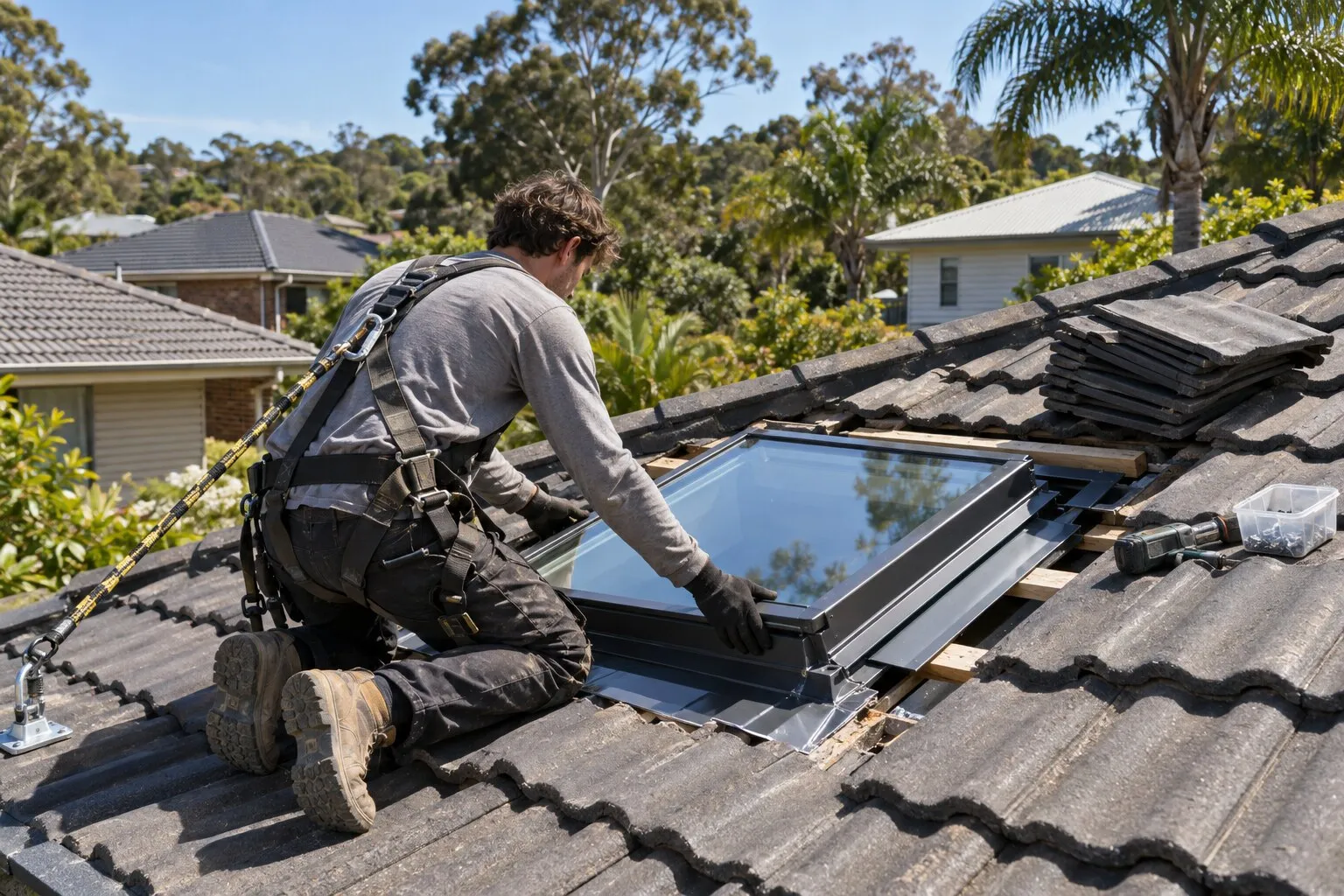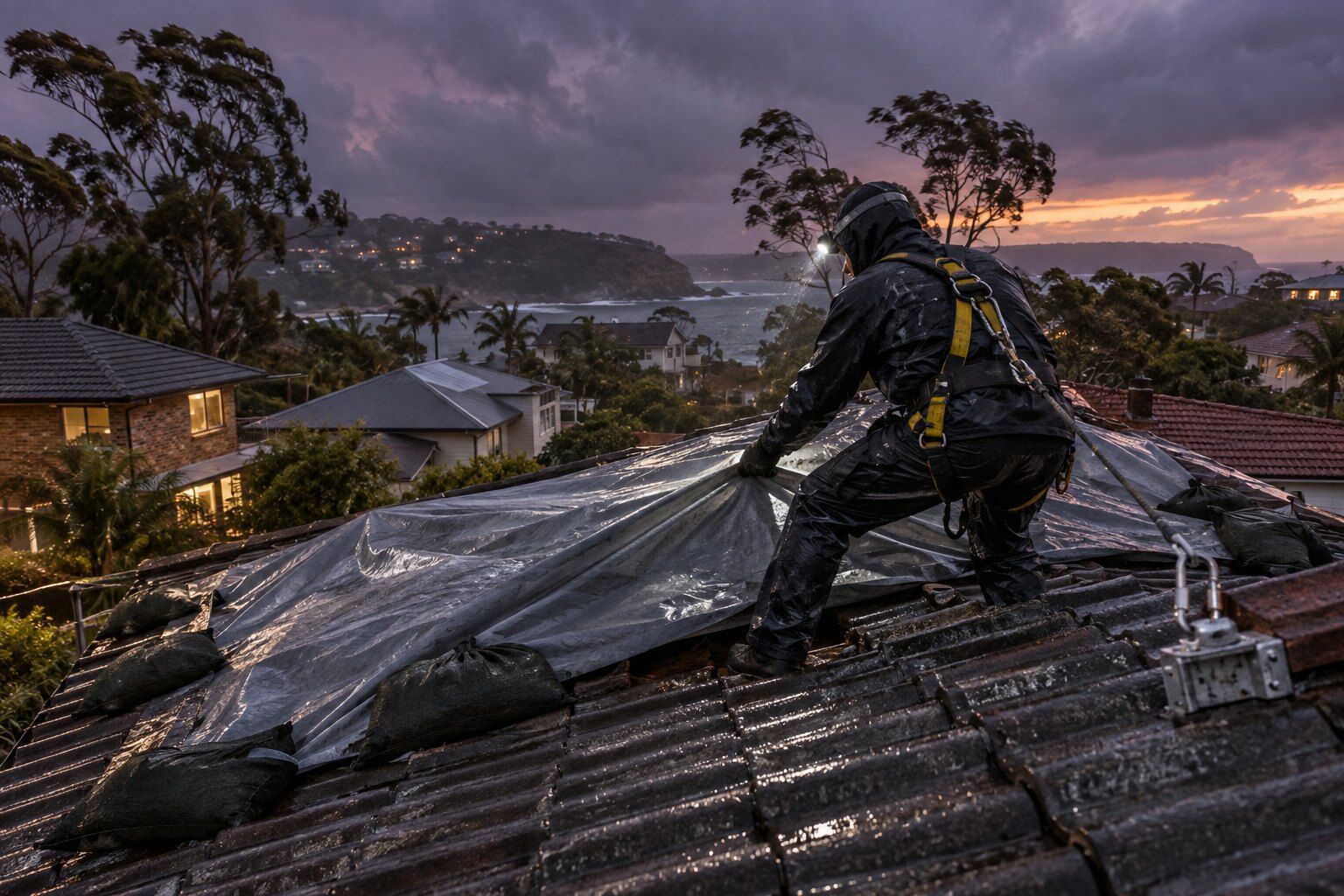
In a storm, call these first
- Life at risk: Triple Zero (000).
- Storm damage to the roof: NSW SES on 132 500.
Who to call after storm damage
During the July 2025 east coast low, Northern Beaches Council’s advice was: “If you have any issues with flooding, roof damage or dangerous trees call SES on 132 500. In life-threatening situations call Triple Zero (000).” The NSW SES’s own storm page says the same: “For emergency assistance during a flood, storm or tsunami, call NSW SES on 132 500. In a life-threatening emergency, call Triple Zero (000).”
A roofer’s job comes next: a make-safe that keeps the rain out until the roof can be repaired properly, then the permanent repair. When a roofer can get there depends on the roofer and the weather, so for anything that can’t wait, call the SES first.
Stay off the roof, and away from wet ceilings
Until someone has looked at it, this is our advice:
- Don’t climb onto a wet or storm-damaged roof, and don’t try to tarp it yourself in wind or rain. Broken tiles shift underfoot and wet metal is slippery.
- Keep clear of a sagging or bulging ceiling. Wet plasterboard can give way. Move people, pets and belongings out from under it.
- Stay away from wet light fittings and power points. Turn the power off at the switchboard if you can reach it without standing in water, and have a licensed electrician check the circuit before it goes back on.
Roofers work at height under strict rules. SafeWork NSW’s code of practice treats work with a risk of a fall of more than 2 metres as high-risk construction work, and a safe work method statement “must be prepared before the work starts”.
Photos and your insurer
Once it’s safe, take photos before anything is moved, cleaned up or repaired: the roof from the ground, fallen branches, the ceilings and walls inside, water on the floor and damaged belongings. Note the date and time of the storm. Ask the roofer for photos of what they find up on the roof as well.
Then call your insurer early. The NSW SES says: “If you experience damage to your property, contact your insurer as soon as possible to lodge a claim.” What your policy covers, and what it needs from you before the permanent repair starts, are questions for your insurer.
Make-safe first, then the permanent repair
Make-safe: tarps and temporary repairs
A make-safe stops more water getting in. That usually means a heavy tarp fixed or weighted over broken tiles or lifted sheets, loose tiles or sheets secured, temporary tiles slotted into gaps, or a temporary seal at a flashing. A tarp is a stopgap: wind works at it, so the permanent repair shouldn’t wait longer than it has to.
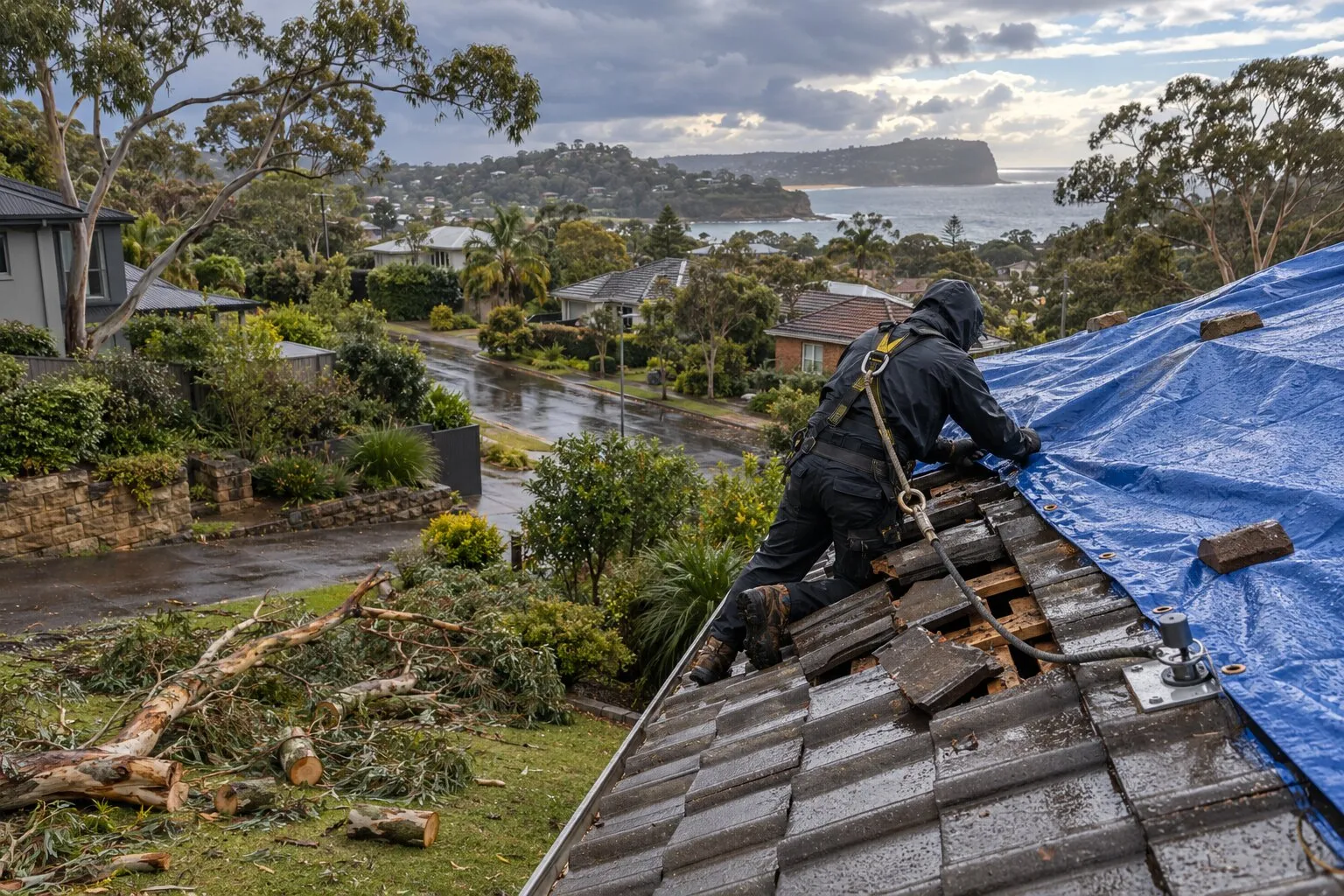
The permanent repair
Once the roof is dry and the damage is clear, the roofer quotes the proper fix: matching tiles, new sheets and screws, rebedded ridge capping, a new valley or flashing, repaired gutters. Where the damage is widespread or the roof was already tired, a partial or full roof replacement may make more sense. If water is still getting in after the make-safe, see roof leak repairs.
Urgent work and NSW contract rules
For ordinary roofing work, the NSW Home Building Act sets out the paperwork. Fair Trading says a written contract is needed when the price is over $5,000, including GST, and work between $5,000 and $20,000 needs a small works contract. Over $20,000, the Act requires a full home building contract and gives you a cooling-off period of 5 clear business days, and icare says most projects need Home Building Compensation Fund insurance before work starts or any payment, including a deposit, is taken.
Section 6(2) of the Act makes an exception for urgent work. The written-contract and cooling-off sections don’t apply where “if the work were not to be done promptly, there is likely to be a hazard to the health or safety of any person or to the public or to be damage to property”, and the work “could not be done promptly” if those requirements had to be met before starting.
In plain words:
- A genuine make-safe in a storm, such as tarping a hole to stop water pouring into the house, can go ahead without the usual contract paperwork first.
- Both conditions have to be met: real risk of harm or damage if it waits, and no way to do it promptly with the paperwork first.
- It’s an exception to the contract rules only. Work over $5,000 still has to be done under the right contractor licence.
- Once the roof is watertight, the rest of the repair can usually wait for a proper quote, and the normal rules apply. The Act also caps a deposit at 10% of the contract price.
Asbestos after a storm
The NSW SES’s recovery advice is to “Check for damage to windows, walls and the roof and be especially cautious of potential contaminants including asbestos.” Northern Beaches Council says “If your home was built or renovated before 1987, it may contain asbestos.” The NSW EPA puts it as “If your house was built before 1990, it probably has asbestos-containing materials.”
If a storm has cracked or broken fibro roof sheets, keep people and pets away from the pieces and don’t break, sweep or hose them. SafeWork NSW says to “Never use high-pressure water or compressed air on asbestos containing materials”, and that “You must always use a licensed asbestos professional to remove friable asbestos and when there is more than 10sqm of non-friable (bonded) asbestos.” It recommends a licensed asbestos professional for any amount of bonded asbestos.
East coast lows and storms on the Northern Beaches
In the records we checked, east coast lows hit the Beaches in June 2016 and July 2025, and a storm in March 2026 brought tree limbs down onto roofs:
Recent storms on the Northern Beaches
| When | Event | What was recorded | Source |
|---|---|---|---|
| 4 to 6 June 2016 | East Coast Low | Sydney’s Northern Beaches listed among the affected areas; insured losses over $304 million state-wide | AIDR Knowledge Hub |
| July 2025 | East Coast Low | Council told residents to call the SES on 132 500 for flooding, roof damage or dangerous trees | Northern Beaches Council, 2 July 2025 |
| 26 March 2026 | Storm | The SES Warringah Pittwater unit responding to more than 50 call-outs, with minor damage from tree limbs on roofs | ABC News, 26 March 2026 |
Checked 1 October 2026. The 2016 and 2026 rows are summarised from the AIDR Knowledge Hub’s record and an ABC News report; the 2025 row is from Northern Beaches Council’s news item of 2 July 2025.
Before the July 2025 low, the council relayed SES advice to “secure or put away items, such as outdoor furniture, trampolines and roofing iron that could blow around in strong winds”. The SES’s advice on preparing your home adds: “Look for any leaks and repair any damage to your roof, including loose tiles, metal sheets and screws.” It also says to clear gutters, downpipes and drains, because “Blockages can trap water and cause it to overflow under the eaves into your roof cavity.”
Storm damage repair prices
Only one Northern Beaches roofer we found publishes storm repair prices. They’re per job, and the roofer prices yours once they’ve seen the damage.
Storm repairs: a Northern Beaches contractor’s published prices
| What’s charged | Published price | Who publishes it |
|---|---|---|
| Minor storm repair: small leak, flashing, a few tiles or fixings | $300 to $1,000 | Cloud9 Roofing, Northern Beaches |
| Partial roof repair: several damaged areas, repointing, sheet or tile replacement | $5,000 to $12,000 | Cloud9 Roofing, Northern Beaches |
A Northern Beaches roofing contractor’s storm-damage page (published 30 April 2026), checked 1 October 2026. It describes these as indicative, gives “Emergency make-safe” as “Varies by urgency and access”, and doesn’t say whether GST is included.
For small repairs, ridge capping and valleys, the roof repair cost guide has published Sydney prices.
Who can do the repair
NSW Fair Trading says you must hold a contractor licence to “carry out, advertise or contract for” building or trade work valued at more than $5,000 in labour and materials, including GST. Storm repairs usually fall under one of two categories:
- Roof tiling covers tiles, tile bedding and pointing, flashing valleys, sarking and battens.
- Roof plumbing covers metal roof coverings, guttering, downpipes and roof flashings.
The contract for work over $5,000 has to show the licence holder’s name and licence number. You can check it on the Service NSW licence register.
What to have ready
- Photos of the damage, inside and from the ground
- What happened and when: a branch, lifted tiles or sheets, water through the ceiling
- What the roof is made of, and whether it’s single or two storey
- Whether a tarp is already on, and who put it there
- Your insurer, and a claim number if you have one
- Whether the house was built before 1990, in case there’s asbestos
Common questions
Who do I call if a storm damages my roof?
In a life-threatening emergency, call Triple Zero (000). For storm damage to the roof, call the NSW SES on 132 500. Then contact your insurer: the SES says to do that “as soon as possible to lodge a claim”. A roofer can then quote the make-safe and the permanent repair.
Can a roofer come out straight away?
That depends on the roofer, the weather and how many roofs were hit, and many roofs can’t be worked on safely until the wind and rain ease. For storm damage that can’t wait, call the NSW SES on 132 500 rather than waiting on a roofer.
Do I need a written contract for emergency roof work?
Not always for the urgent part. Section 6(2) of the NSW Home Building Act switches off the written-contract and cooling-off sections where work has to be done promptly to avoid a hazard or damage to property, and couldn’t be done promptly if those rules were followed first. Once the roof is watertight, the permanent repair is usually quoted and contracted in the normal way: in writing over $5,000, including GST.
How much does storm damage roof repair cost?
A Northern Beaches roofing contractor publishes $300 to $1,000 for a minor storm repair (a small leak, a flashing, a few tiles or fixings) and $5,000 to $12,000 for a partial roof repair across several damaged areas. It gives emergency make-safe as “Varies by urgency and access”. See roof repair cost.
My house has a fibro roof. What should I do after a storm?
Keep people and pets away from broken pieces and don’t break, sweep or hose them. The NSW SES says to be “especially cautious of potential contaminants including asbestos” after a storm. SafeWork NSW says a licensed asbestos professional must remove more than 10 m² of bonded asbestos, and recommends one for any amount.
Where these figures come from
The prices, rules and official advice on this page come from these published pages, checked on 1 October 2026.
- Cloud9 Roofing & Guttering: storm damage roof repair Northern Beaches · Northern Beaches roofing contractor (2099), published 30 April 2026
- Northern Beaches Council: East Coast Low, get prepared · Local council news item, 2 July 2025
- NSW SES: during a storm · NSW State Emergency Service guidance, undated
- NSW SES: prepare your home · NSW State Emergency Service guidance
- NSW SES: recovery · NSW State Emergency Service guidance, undated
- ABC News: severe weather and storm calls across Sydney · News report, 26 March 2026
- AIDR Knowledge Hub: East Coast Low and storm, 2016 · Australian Institute for Disaster Resilience record of the June 2016 event
- Home Building Act 1989 (NSW), sections 6, 7, 7AAA, 7BA and 8 · NSW legislation: urgent work, written contracts, cooling-off and deposits
- NSW Government: guide to providing home building contracts · NSW Fair Trading guidance, updated 11 June 2026
- icare: do I need HBCF? · NSW Home Building Compensation Fund, undated page
- SafeWork NSW: Code of Practice, managing the risk of falls in housing construction · NSW work health and safety regulator, approved code of practice, August 2019 edition
- SafeWork NSW: asbestos · NSW work health and safety regulator, updated 14 August 2026
- SafeWork NSW: managing risks of exposure to asbestos · NSW work health and safety regulator, updated 30 June 2025
- NSW EPA: dealing with household asbestos · NSW Environment Protection Authority, updated 22 November 2025
- Northern Beaches Council: asbestos · Local council guidance, undated
- NSW Government: roof tiling work licence · NSW Fair Trading licence page, updated 23 June 2026
- NSW Government: roof plumbing work licence · NSW Fair Trading licence page, updated 23 June 2026
- Service NSW: check a trade licence · NSW Government licence register
Related guides
- Does home insurance cover a leaking roof or storm damage?Storm vs wear and tear, what Moneysmart and AFCA say, photos, make-safe repairs, claim timeframes and complaints.