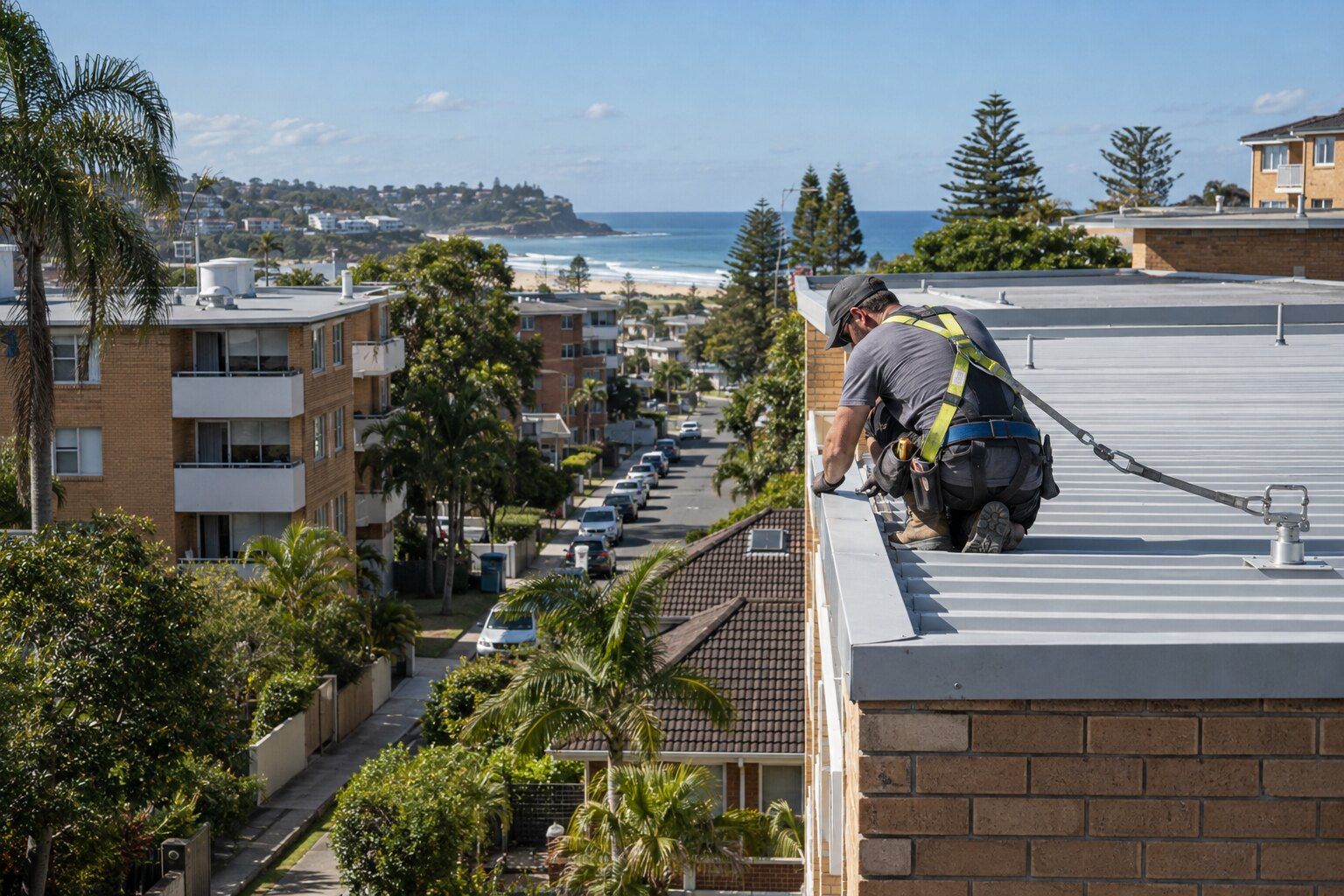
For a shared roof in Dee Why, identify the affected building or section and whether the owners corporation is arranging the enquiry. Dee Why Lagoon and its reserve form a heritage conservation area on the suburb’s border with Collaroy. The Roofing Northern Beaches guides explain the work and local checks.
Dee Why had 11,001 private dwellings at the 2021 Census. Of the 9,863 occupied ones, 8,073 (81.9%) were flats or apartments, against 21.7% across NSW, and 1,512 (15.3%) were separate houses. Council’s Local Housing Strategy notes “the high number of walk-up flats to the east of Pittwater Road”.
Strata roofs: who arranges the repair
NSW Government guidance says “The owners corporation is responsible for maintenance and repair of common property”, and puts “Roof and gutters” with the owners corporation “In most cases”. If water comes through an apartment ceiling, tell the strata manager or committee; for a freestanding house, the roof is the owner’s to arrange. Roof leak repairs explains how a leak is traced to where the water gets in, and strata roof leaks in NSW covers emergency repairs and what to do if the leak isn’t fixed.
The town centre has its own controls (Part G1 of the Warringah DCP), written for new towers: where a tower roof has no solar panels, “at least 30% of the roof space is to be provided as a green roof or garden.” By our reading, they don’t apply to repairing an existing roof.
Colour, glare and heritage for Dee Why houses
Dee Why is in the former Warringah council area, so the Warringah LEP 2011 and DCP 2011 apply until the single Northern Beaches plans, exhibited in mid-2026, commence; council expects that in mid-2027. For houses, the DCP asks that “Roofs should complement the roof pitch and forms of the existing buildings in the streetscape” and that colours on alterations “complement the existing external building façade”. Close to the lagoon, the reserves and the beach, colours and materials “must blend in to the natural landscape”. By our reading, these controls apply when the work needs a development application.
Dee Why has a long heritage list, but few of its items are homes. The state heritage map places mostly civic buildings, two churches, the rock pool and small pieces such as a bus shelter in Dee Why, with a small number of houses and flats. Its heritage conservation areas are reserves (the lagoon, Stony Range and the coastal cliffs), not streets. For listed homes, council’s heritage FAQ says “If you wish to repair, change or renovate your heritage-listed property you need to lodge a development application”; your planning certificate shows whether yours is listed.
The lagoon’s bush fire edge, the headland and salt
About 4% of Dee Why’s residential land is on council’s bush fire prone land map, by our calculation from council map data, all of it buffer land near the bushland of Dee Why Lagoon Reserve. On mapped land, an exempt re-roof must “be adequately sealed or protected to prevent the entry of embers” and “use equivalent or improved quality materials”.
Most Dee Why homes sit back from the surf: by our calculation, about 6% of residential land is within 200 metres of the ocean coastline and about 19% within 500 metres. At Dee Why Head the Warringah DCP records “Near vertical cliffs to approximately 50m high”. Near the beach or the headland, check BlueScope’s distances in steel roofs near the coast before choosing a steel roof.
Dee Why was among the suburbs hit by the severe storm cell of 19 December 2021. ABC News reported emergency services crews “were called to multiple sites across the area from Dee Why to Forestville where trees, roofs and power poles were ripped out.” For storm damage, council’s advice is to call the NSW SES on 132 500.
Roofing work in Dee Why
Choose the work you’re planning in Dee Why, then describe the roof material, condition and access:
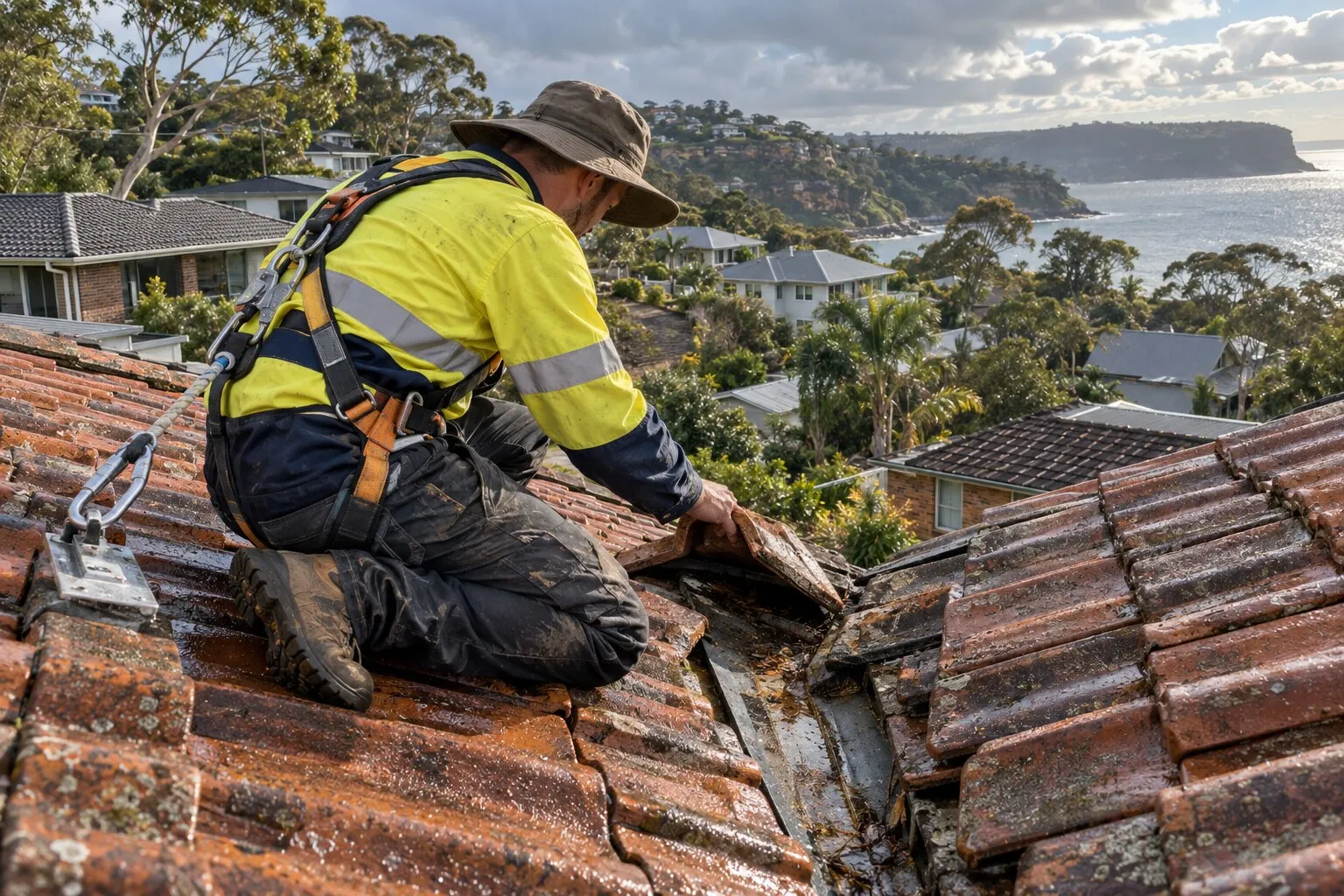
- Roof repairs: cracked and slipped tiles, ridge capping, valleys, flashings and rusted metal.
- Roof leak repairs: leaks traced back to where the water gets in, then fixed there.
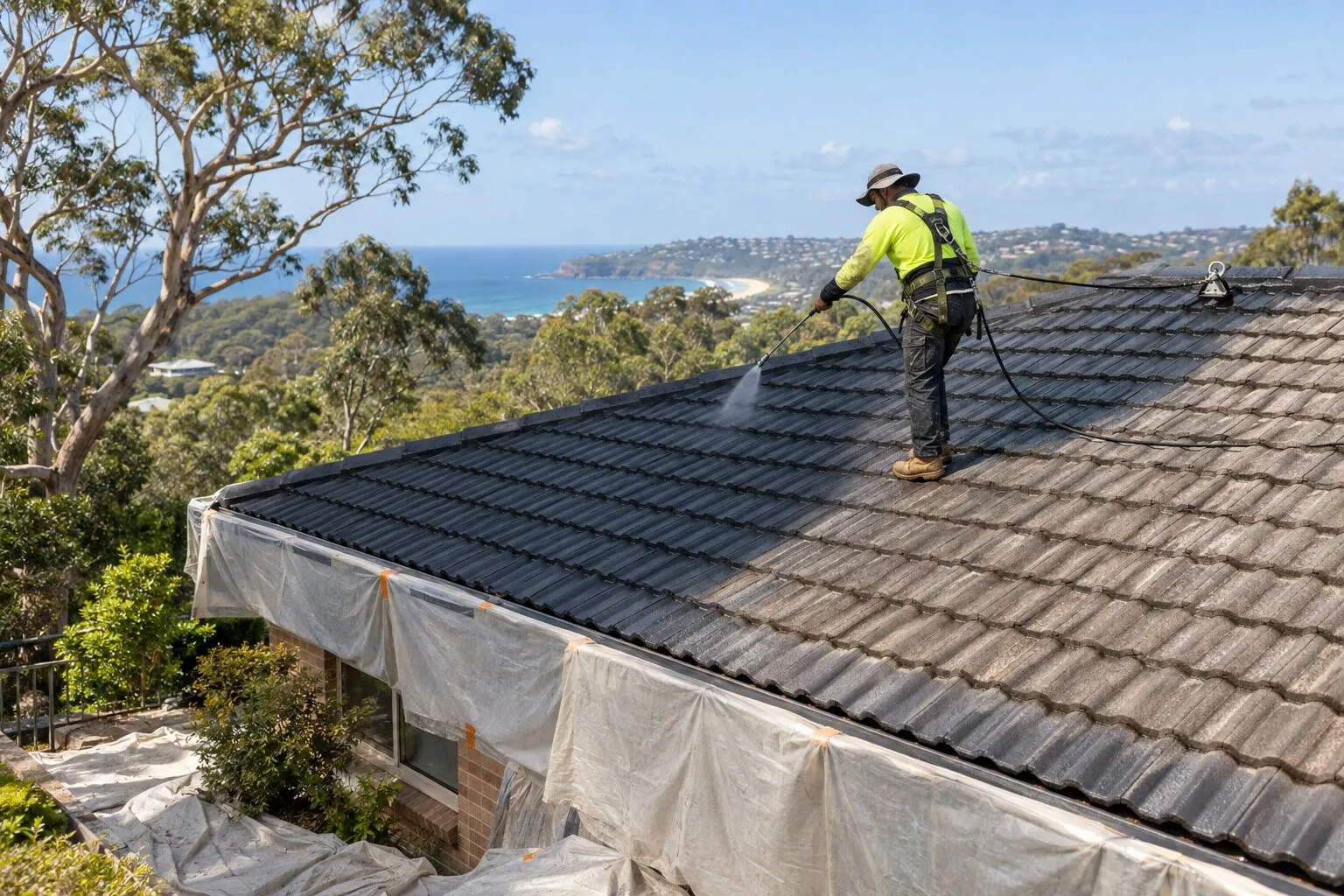
- Roof restoration: clean, repair, rebed, repoint and recoat a roof that’s still sound.
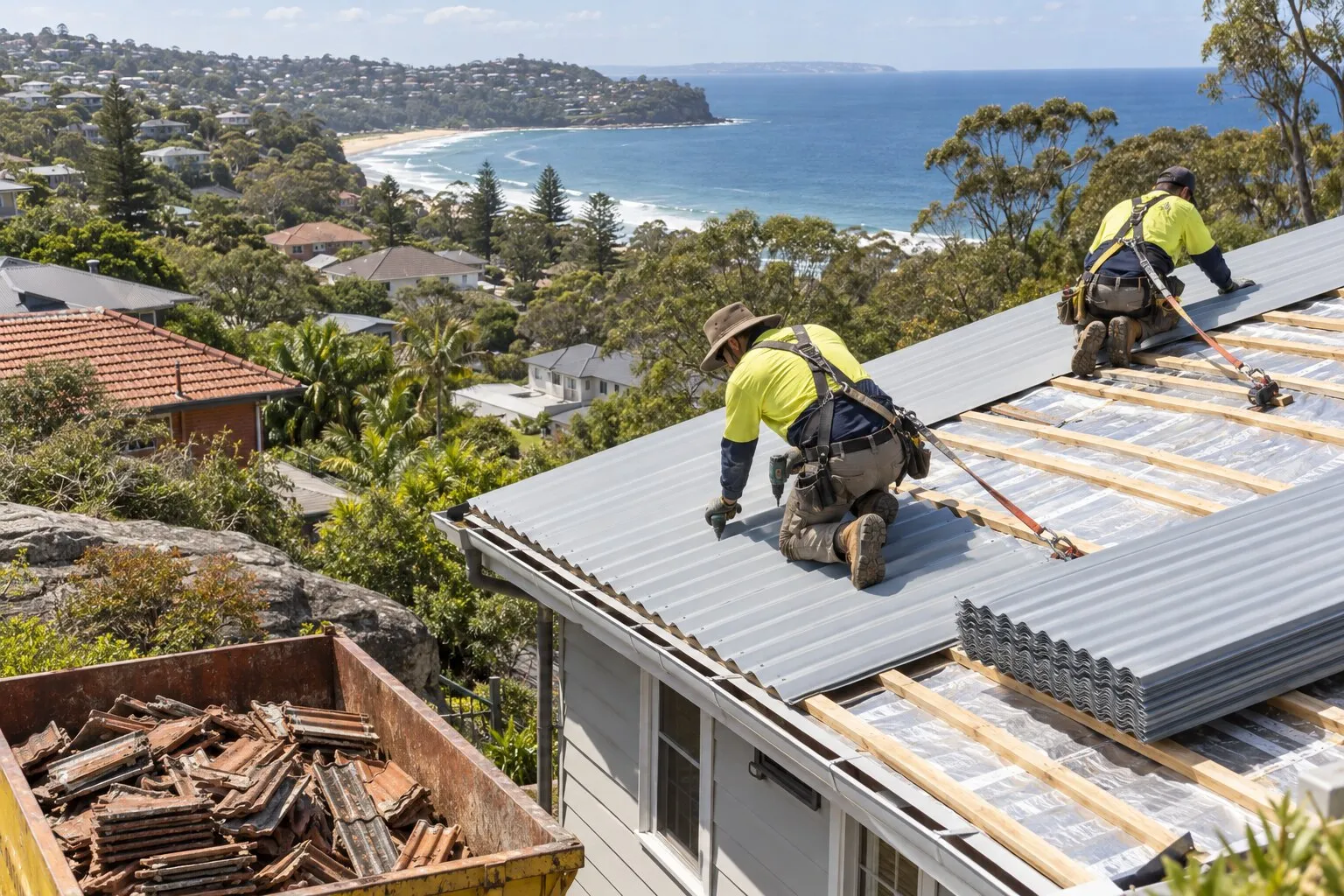
- Roof replacement: old tile, iron or fibro roofs stripped and replaced, in Colorbond or new tiles.
- Gutters and gutter guard: gutters, downpipes and metal gutter guard.
Before re-roofing in Dee Why
Whether a new roof needs approval depends on the property, not just the suburb: whether it’s a heritage item or in a heritage conservation area, whether it’s on bush fire prone land, and whether the old roof contains asbestos. Your property’s planning certificate shows its heritage and bush fire status, and Northern Beaches Council explains exempt and complying development. The roofer should confirm the approval pathway with the quote. See roof replacement for the conditions.
Nearby suburbs
- Roofing in Curl Curl
- Roofing in Brookvale
- Roofing in Collaroy
- Roofing in Narrabeen
- Roofing across the Northern Beaches
Common questions
Who arranges a roof repair on a Dee Why apartment block?
In most cases, the owners corporation: NSW Government guidance lists roofs and gutters among the common-property repairs it’s usually responsible for. The strata manager can confirm how that applies to your building.
Do the town centre’s green roof rules apply to my building?
They’re written for new development: Part G1 of the Warringah DCP asks for a green roof or garden on at least 30% of a tower’s roof space where there are no solar panels. By our reading, it doesn’t apply to repairing an existing roof.
Is my Dee Why house in a heritage conservation area?
Probably not. By our reading of the state heritage map, Dee Why’s heritage conservation areas are reserves, not residential streets, though a few individual houses are heritage items. Your section 10.7 planning certificate shows your property’s status.
Is Dee Why bush fire prone?
Parts are. About 4% of Dee Why’s residential land is on council’s bush fire prone land map, by our calculation, all of it buffer land near Dee Why Lagoon Reserve. On mapped land, an exempt re-roof must “be adequately sealed or protected to prevent the entry of embers” and “use equivalent or improved quality materials”. Your planning certificate shows whether your property is mapped.
Where this information comes from
The local details on this page come from these published pages, checked on 1 October 2026.
- ABS: 2021 Census QuickStats, Dee Why · Australian Bureau of Statistics, housing and dwelling figures
- Northern Beaches Council: Local Housing Strategy · Council strategy, adopted December 2021
- NSW Government: strata repairs and maintenance · NSW Government guidance, updated 22 June 2026
- Warringah Development Control Plan 2011: D10, D11, D12, E10 and Part G1 Dee Why Town Centre · Council planning controls (live viewer), amendment 23 commenced 15 September 2025
- Northern Beaches Council: A clearer set of planning rules for the Northern Beaches · Council media release, 20 July 2026
- State Environmental Planning Policy (Exempt and Complying Development Codes) 2008, clauses 2.53 and 2.54 · NSW planning law: minor external building alterations, including roof cladding
- Northern Beaches Council: FAQs about heritage · Local council guidance, undated
- Northern Beaches Council: bush fire prone land · Local council guidance; map certified 7 August 2020
- BlueScope TB-1A: steel roofing products selection guide · Manufacturer technical bulletin, March 2023, revision 14
- Northern Beaches Council: East Coast Low, get prepared · Local council news item, 2 July 2025
- ABC News: report on the severe storm on Sydney’s northern beaches, 19 December 2021 · National news report, 19 December 2021
- NSW Planning: heritage, zoning and land application map layers, and the bush fire prone land layer · NSW Government map data, used for our area calculations (bush fire prone land as certified 7 August 2020)
- NSW Spatial Services: suburb boundaries, coastline and water areas · NSW Government map data, used for our distance and area calculations