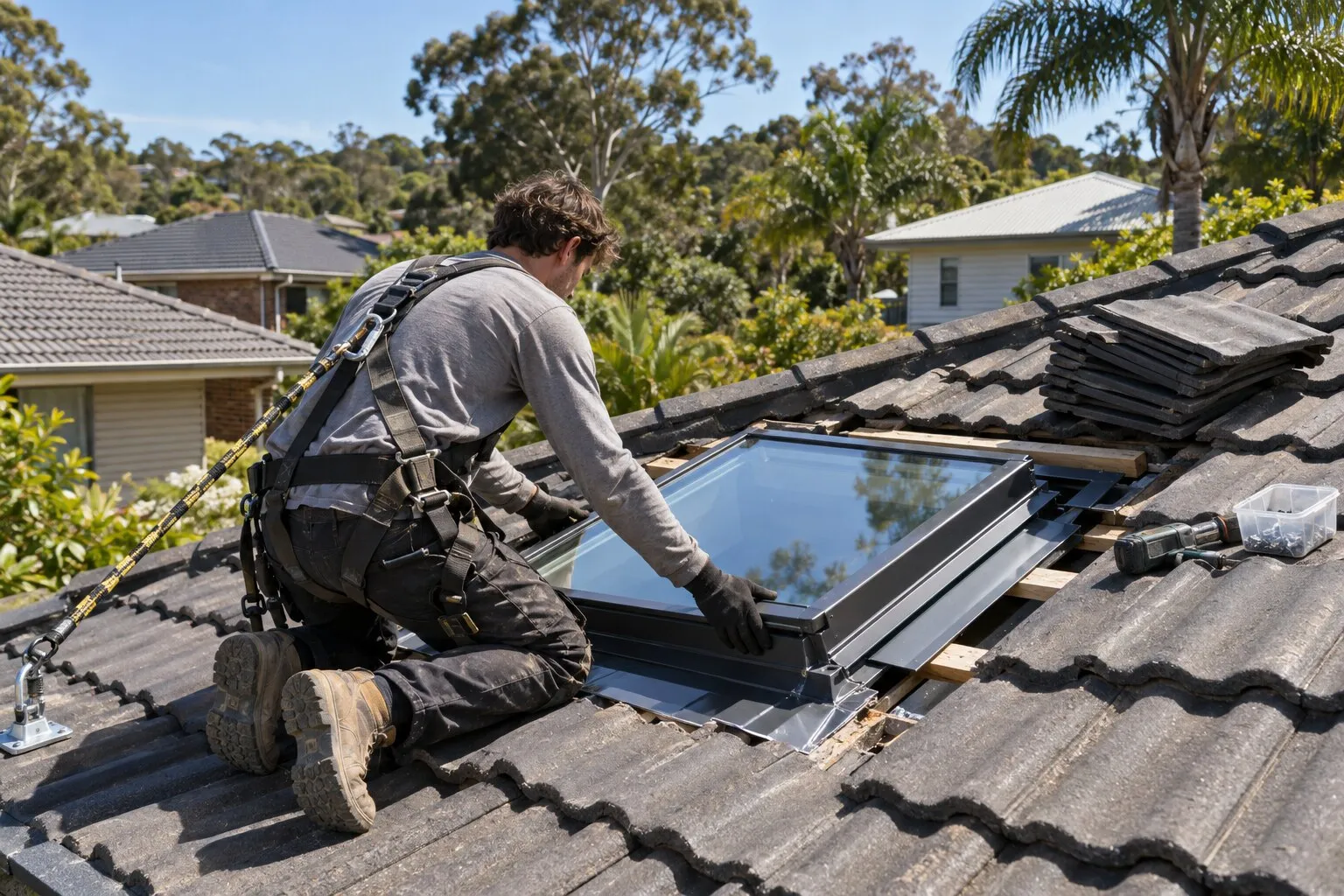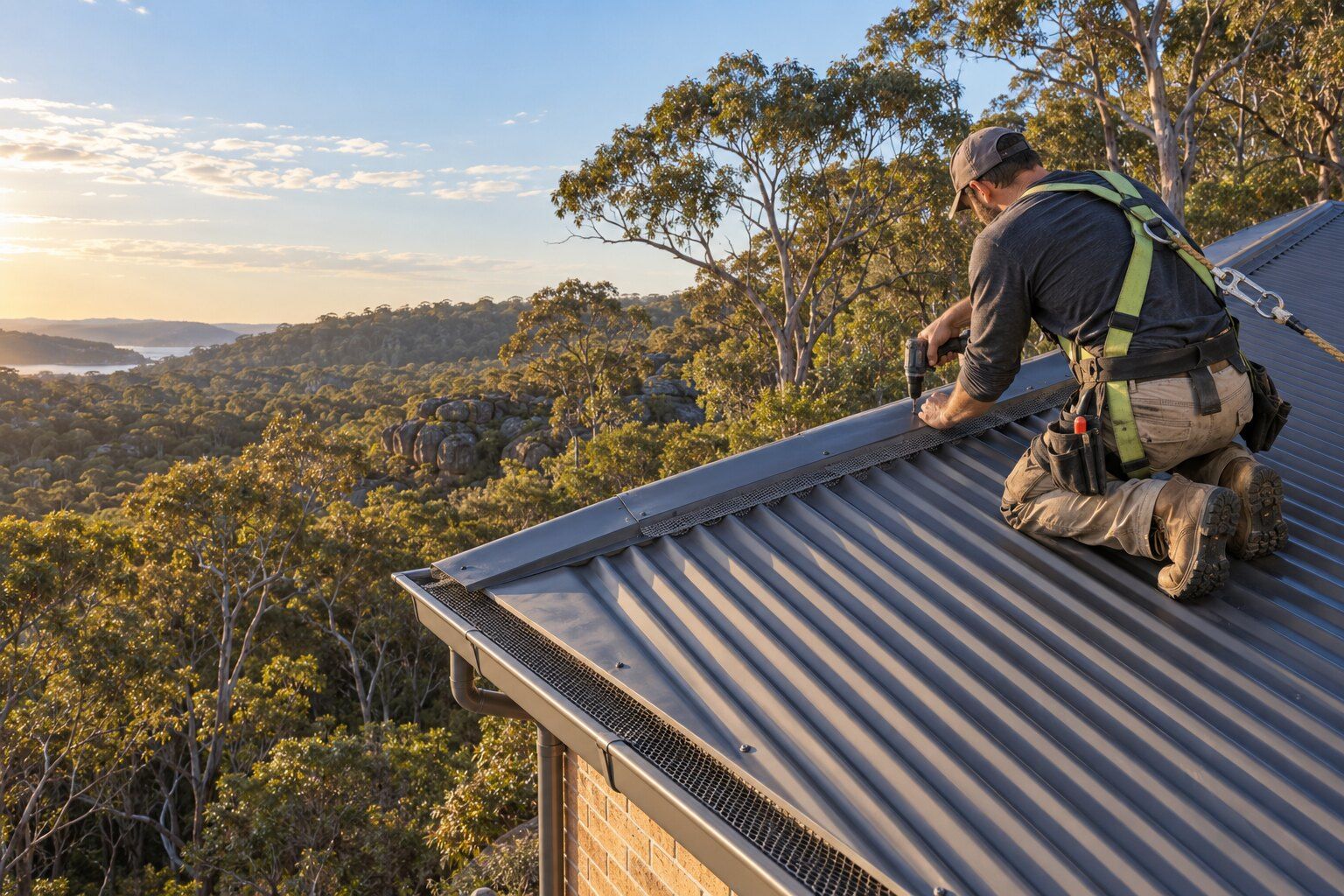
Much of the Northern Beaches backs onto national park and bushland, from Belrose and Terrey Hills to the Pittwater ridges. If your block is on bush fire prone land, its bushfire attack level (BAL) sets how the roof has to be built. This tool summarises the NSW rules from the NSW Rural Fire Service and the best practice from CSIRO. It doesn’t reproduce Australian Standard AS 3959, which is a paid standard.
BAL roofing requirements checker
Your BAL is on the BAL certificate or bush fire assessment report for the property.
Your result
Choose your BAL, roof type and the work above. The NSW rules it draws on are set out below.
Is your property on bush fire prone land?
- Use the NSW RFS “Check if you’re in bush fire prone land” tool. The RFS says “The outcome of your search is only valid for the day of the enquiry is made.”
- Or look at Northern Beaches Council’s bush fire prone land page, which links its map. Council says the map was certified by the NSW RFS Commissioner on 7 August 2020 and is reviewed every 5 years.
- Confirm it on the section 10.7 planning certificate for the property, which you can order from council.
The BAL itself comes from a site assessment. PBP 2019 describes a BAL certificate as “A certificate issued to identify the BAL of a proposed development in the complying development process”, issued by the council or a consultant “accredited by a recognised accreditation scheme”.
What each bushfire attack level means
NSW RFS: bushfire attack levels
6 rows
| Level | Radiant heat (kW/m²) | What it means |
|---|---|---|
| BAL-LOW | N/A | Minimal attack from radiant heat and flame due to the distance of the building from the vegetation, although some attack by burning debris is possible. There is insufficient threat to warrant specific construction requirements. |
| BAL-12.5 | ≤12.5 | Attack by burning debris is significant with radiant heat (not greater than 12.5kW/m²). Radiant heat is unlikely to threaten building elements (such as unscreened glass). Specific construction requirements for ember protection and accumulation of debris are warranted. |
| BAL-19 | >12.5 ≤19 | Attack by burning debris is significant with radiant heat flux (not greater than 19kW/m²) threatening some building elements (such as screened glass). Specific construction requirements for embers and radiant heat are warranted. |
| BAL-29 | >19 ≤29 | Attack by burning debris is significant and radiant heat flux (not greater than 29kW/m²) threatens building integrity. Specific construction requirements for ember and higher levels of radiant heat are warranted. Some flame contact is possible. |
| BAL-40 | >29 ≤40 | Radiant heat flux and potential flame contact could threaten building integrity. |
| BAL-FZ | >40 | Significant radiant heat and significantly higher likelihood of flame contact from the fire front will threaten building integrity and result in significant risk to residents. |
Planning for Bush Fire Protection 2019, Table A1.7, quoted as published and checked 6 October 2026. PBP 2019 notes “Attack from burning debris increases with the Bush Fire Attack Level. Source AS 3959.”
NSW roof rules that apply on top of AS 3959
In NSW, new homes and additions on bush fire prone land are built to “construction provided in accordance with the NCC and as modified by section 7.5” of PBP 2019. That section varies AS 3959 for the roof in three ways:
- Sarking, BAL-12.5 to BAL-40. “clause 3.10 of AS 3959 is deleted and any sarking used for BAL-12.5, BAL-19, BAL-29 or BAL-40 shall: be non-combustible; or comply with AS/NZS 4200.1, be installed on the outside of the frame and have a flammability index of not more than 5 as determined by AS 1530.2”.
- Fascias and bargeboards, BAL-40. “fascias and bargeboards, in BAL-40, shall comply with: clause 8.4.1(b) of AS 3959; or clause 8.6.6 of AS 3959.”
- Flame contact, BAL-40 and BAL-FZ. “For development which may be subject to flame contact (BAL-40 and BAL-FZ), systems tested in accordance with AS 1530.8.1 and AS 1530.8.2 respectively will be considered, except that there is to be no flaming of the specimen”, apart from narrow exceptions.
At BAL-FZ, “The NSW variation to the NCC excludes both AS 3959 and the NASH Standard as a Deemed to Satisfy solution for buildings that are required to be constructed to BAL-FZ as defined in AS 3959.” PBP 2019 adds: “Although Chapter 9 of AS 3959 and the NASH Standard has not been adopted, they should still be used as a basis for a performance based solution”.
Embers, roof penetrations and gutter guards
The detailed rules for ember gaps, ember guards, vents, skylights, roof-mounted evaporative coolers and gutter and valley guards at each BAL are in AS 3959, a paid Standards Australia publication. Your BAL certificate or bush fire consultant will specify them for your roof.
What CSIRO recommends beyond the minimum
CSIRO’s Bushfire best practice guide goes further than the code. On sarking, it warns: “Do not assume that conventional sarking (even level 5 rated) is an ember or flame barrier in a combustible roof cavity.” On gaps, it says “it is technically difficult to design and build a roof that has no gaps greater than 2mm.” On gutters: “Gutters that are non-combustible and are entirely covered with metal mesh limits debris build up in the gutter and helps to limit the size of fire that can occur in the gutters. Using mesh with an aperture of less than 2mm and tightly fixed to the gutter line and roof further reduce the likelihood that embers may ignite any fine debris.”
CSIRO: retrofitting an existing roof
2 rows
| Roof | To protect from fires up to BAL 12.5 | To protect from fires up to BAL 29 |
|---|---|---|
| Timber frame, steel roof | Seal any gaps larger than 2mm | As for BAL 12.5 with the addition of:; Replace the timber battens with steel battens; Seal ridges and eaves with non-combustible insulation or flashings to resist ember and localised flame attack; Replace combustible fascia’s and eaves with non-combustible alternatives; Fully wrap the framing trusses with flame resistant sarking |
| Timber frame, tiled roof | Seal any gaps larger than 2mm | As for BAL 12.5.; Seal ridges and eaves with non-combustible insulation or flashings to resist ember and localised flame attack; Replace combustible fascia’s and eaves with non-combustible alternatives; Use steel roofing battens under the tiles and fully wrap the framing trusses with flame resistant sarking |
CSIRO Bushfire best practice guide, retrofits, roofs (page modified 10 October 2021), quoted and checked 6 October 2026. CSIRO says these measures “will provide some protection against most bushfire hazards, however they may not protect against direct flame contact from burning vegetation or consequential fires.”
CSIRO: new steel roofs
3 rows
| Roof system | Protection CSIRO gives it |
|---|---|
| Non-combustible frame, non-combustible fascia and eaves, seals ridge and eaves to stop ember and debris accumulation | BAL-29 |
| Seals ridge and eaves, foil blanket insulation (See the NASH standards for more information) | BAL-FZ |
| 60min fire-rated roof design | BAL-FZ and protection from consequential fire |
CSIRO Bushfire best practice guide, new builds, roofs (page modified 10 October 2021), checked 6 October 2026.
CSIRO: new tiled roofs
3 rows
| Roof system | Protection CSIRO gives it |
|---|---|
| Non-combustible frame, non-combustible fascia and eaves, seals ridge and eaves to stop ember and debris accumulation | BAL-29 |
| 30min fire-rated roof design | BAL-FZ |
| 60min fire-rated roof design | BAL-FZ and protection from consequential fire |
CSIRO Bushfire best practice guide, new builds, roofs, checked 6 October 2026. CSIRO also says: “Do not install a tiled roof with combustible battens and frames.”
Approvals: complying development, a DA or exempt re-roofing
- New homes and additions up to BAL-29. PBP 2019: “Complying Development can be undertaken on lower risk BFPL up to and including BAL-29 where the appropriate construction requirements and all other relevant development standards have been met.” For Complying Development, a BAL Certificate from the local council or a recognised consultant stating that the BAL of the development is not BAL-40 or BAL-FZ as applicable must be obtained prior to the issue of a Complying Development Certificate (CDC).
- BAL-40 and BAL-FZ. “Complying Development is not permitted on higher risk BFPL (BAL-40 or BAL-FZ) and a DA is required in these circumstances.”
- Replacing the roof on an existing home. Under the NSW Codes SEPP, roof cladding replacement can be exempt development; on bush fire prone land the work must “be adequately sealed or protected to prevent the entry of embers” and “use equivalent or improved quality materials”. The NSW RFS says “Upgrading of existing building elements is not mandatory.” Heritage and other conditions apply: see does a re-roof need council approval?
Keeping the roof ready for fire season
Among its steps to prepare a home, the NSW RFS lists “Clean your gutters of leaves and twigs” and “Install metal gutter guards”. Clearing gutters is ladder work at the edge of the roof: do what’s safe from the ground, and leave the roof itself to someone with fall protection. For gutter work and metal mesh guard, see gutters, downpipes and gutter guard.
Common questions
Does BAL-LOW need anything special on the roof?
No. The NSW RFS table for BAL-LOW says “There is insufficient threat to warrant specific construction requirements.” Some attack by burning debris is still possible, so keeping gutters clear still makes sense.
Is gutter guard required in a bushfire zone?
The requirements for gutter and valley guards sit in AS 3959 itself, and your BAL certificate or bush fire consultant will specify them. The NSW RFS advises homeowners to clean gutters of leaves and twigs and install metal gutter guards, and CSIRO’s guide says non-combustible gutters fully covered with metal mesh, with an aperture of less than 2mm, limit debris build-up.
Where this information comes from
The rules in this tool on this page come from these published pages, checked on 6 October 2026.
- NSW RFS: Planning for Bush Fire Protection 2019 · NSW Rural Fire Service, adopted 1 March 2020
- NSW RFS: Planning for Bush Fire Protection (current version and addendums) · NSW Rural Fire Service, undated page
- NSW RFS: check if you’re in bush fire prone land · NSW Rural Fire Service online check, undated page
- Northern Beaches Council: bush fire prone land · Local council guidance; map certified 7 August 2020
- CSIRO: Bushfire best practice guide, roofs (new builds) · CSIRO guidance, page modified 10 October 2021
- CSIRO: Bushfire best practice guide, roofs (retrofits) · CSIRO guidance, page modified 10 October 2021
- State Environmental Planning Policy (Exempt and Complying Development Codes) 2008, clauses 2.53 and 2.54 · NSW planning law: minor external building alterations, including roof cladding
- NSW RFS: building on bush fire prone land, what you need to know · NSW Rural Fire Service guidance on upgrading existing buildings, undated page
- NSW RFS: prepare your home · NSW Rural Fire Service guidance