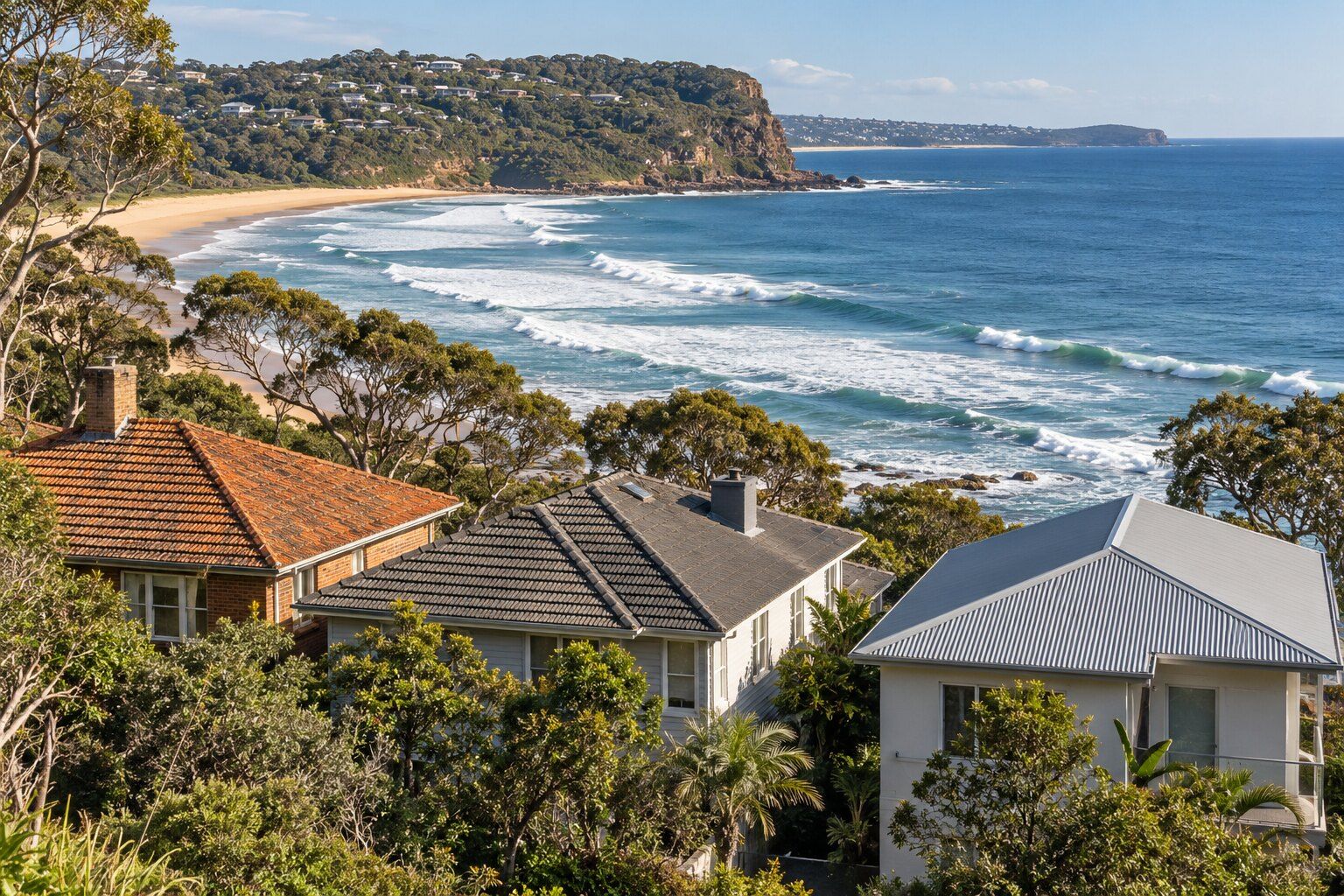
The short answer
All three suit the Beaches if the right product goes on. Tiles are about ten times heavier than steel: Monier lists 47.25 kg per m² of roof for a Marseille terracotta tile and 49.5 kg for an Elabana concrete tile, against 4.35 kg for Lysaght Custom Orb in Colorbond steel. Monier says its tiles are “salt safe”; steel near the surf comes down to the grade, with BlueScope recommending standard Colorbond more than 200 m from breaking surf and Colorbond Ultra more than 100 m away. One Sydney contractor publishes re-roofing from $170 per m² for Colorbond, $180 for concrete tile and $200 for terracotta.
Terracotta, concrete and metal compared
These are single products from the manufacturers’ own pages, not averages for each material, but they show the differences that matter.
Three roofs, by the manufacturers’ figures
| Figure | Terracotta tile (Monier Marseille) | Concrete tile (Monier Elabana) | Steel (Lysaght Custom Orb, 0.42 mm, Colorbond) |
|---|---|---|---|
| Weight per m² of roof | 47.25 kg | 49.5 kg | 4.35 kg |
| Lowest pitch | 15° with sarking, 20° without | 15° with sarking, 20° without | 5° |
| Salt air | Monier: “salt safe” | Monier: “salt safe” | BlueScope: Colorbond (Classic finish) > 200m from breaking surf; Colorbond Ultra > 100m; Superdura stainless at any distance (> 0m) |
| Colour | Monier: colour “baked into the tile”, doesn’t fade | Monier: colour “will fade and weather over time” | Factory-painted; choose from the current Colorbond range |
Monier’s Marseille and Elabana product pages (modified 10 November 2025) and FAQ (updated 22 September 2026); Lysaght’s Custom Orb brochure (July 2024); BlueScope TB-1A (March 2023), Table 1, distances “measured from the high water/tide mark”, which BlueScope calls “a GUIDE ONLY”. Checked 12 October 2026.
Salt air and wind on the Beaches
Tiles don’t rust. Monier’s FAQ says “All Monier concrete and terracotta roof tiles are salt safe and will not corrode over time.” What corrodes on a tile roof near the beach is the metal around it: valleys, flashings, gutters and fixings.
With steel, the grade decides how long it lasts by the sea. BlueScope’s selection guide puts standard Colorbond more than 200 m from breaking surf or exposed marine conditions, Colorbond Ultra more than 100 m away, and Superdura stainless closer than that. Screws follow the same logic. Our guide to Colorbond, Ultra or Zincalume near the coast has BlueScope’s table and Lysaght’s screw classes, and the coastal roof material finder works it out for your distance.
Wind is the other coastal load. Monier says “The weight of concrete and terracotta roof tiles offer more resistance to high winds” than lighter materials. Steel holds down through its screws and battens, so the fixing pattern matters as much as the sheet.
Weight: swapping tiles for steel, or steel for tiles
Going from tiles to steel takes roughly 40 kg off every square metre of roof, by the figures above. That’s one reason tile-to-Colorbond is a common change on older Beaches houses, and why a frame that has sagged under tiles is often fine under steel.
Going the other way, from an old iron roof to tiles, puts about ten times the weight on a frame that was never built for it. Ask for the roof frame to be checked before choosing tiles for a house that has always had a metal roof. Tiles also need a steeper pitch: 15° with sarking on both Monier tiles above, against 5° for Custom Orb, so a low-pitched skillion or extension usually stays metal.
Looks, colour, heat and the neighbours
Terracotta keeps its colour: Monier says “Terracotta tiles, however, do not fade as the colour is baked into the tile.” Concrete tiles are cheaper but their colour “will fade and weather over time”, which is why so many concrete roofs on the Beaches get painted during a restoration. Steel comes in a fixed range of Colorbond colours.
Lighter colours reflect more summer sun, and some parts of the Northern Beaches have council controls on roof colour and reflectivity. If the house is a heritage item or in a heritage conservation area, a change of material needs council’s say first. See does a re-roof need council approval?
Tiles, steel and bush fire
Tile and steel roofs are both used on the Beaches’ bush fire prone land. What each needs depends on the bushfire attack level (BAL): the sarking, the battens, sealing at the ridge and eaves, and gutter guard all come into it, and the detail differs between metal and tile roofs. The BAL roofing requirements checker sets out what NSW and CSIRO say for metal, concrete and terracotta roofs.
What each material costs to re-roof
One Sydney contractor publishes a starting rate for each material, supplied and installed with the old roof stripped:
Published Sydney re-roofing rates by material
| What’s charged | Published price | Who publishes it |
|---|---|---|
| Colorbond and metal, per m² of roof | from $170 | Aussie Roof Repairs, Sydney (undated) |
| Concrete tile, per m² of roof | from $180 | Aussie Roof Repairs, Sydney (undated) |
| Terracotta tile, per m² of roof | from $200 | Aussie Roof Repairs, Sydney (undated) |
One Sydney contractor’s published rates, checked 1 October 2026. The page is undated and doesn’t say whether GST is included. It says the rates include “stripping the old roof, new sarking and standard flashings”, and that two-storey access, a pitch over 30° and complex roofs cost extra. By our arithmetic its typical totals work out at $187.50 to $225 per m² for Colorbond ($37,500 ÷ 200 and $45,000 ÷ 200), above its own “from” rate.
Monier’s FAQ says it is “not uncommon” for terracotta tiles “to provide more than century of service”. That’s a manufacturer’s claim, but it explains why many Beaches terracotta roofs are re-laid on new battens and sarking rather than replaced, keeping the tiles. Ask the roofer whether yours can be.
Common questions
Which is better, terracotta or concrete roof tiles?
Terracotta costs more but keeps its colour: Monier says the colour is baked into the tile. Concrete tiles cost less, but Monier says their colour will fade and weather. Their weight and minimum pitch are similar. Monier says both are salt safe.
Is a metal roof or a tile roof better near the beach?
Either works with the right product. Tiles don’t corrode, though the flashings and fixings around them do. Steel depends on the grade: BlueScope recommends standard Colorbond more than 200 m from breaking surf, Colorbond Ultra more than 100 m away, and stainless closer than that.
How much heavier is a tile roof than a Colorbond roof?
About ten times. Monier lists 47.25 kg per m² of roof for its Marseille terracotta tile and 49.5 kg for its Elabana concrete tile; Lysaght lists 4.35 kg per m² for Custom Orb in 0.42 mm Colorbond steel.
Is Colorbond cheaper than tiles?
On one Sydney contractor’s published rates, slightly: from $170 per m² for Colorbond and metal, from $180 for concrete tile and from $200 for terracotta, supplied and installed with the old roof stripped. See the roof replacement cost guide.
Can I replace a tile roof with Colorbond on the Northern Beaches?
Often, and replacing roof cladding is commonly exempt development in NSW, but not on a heritage item or in a heritage conservation area, and bush fire prone land has its own conditions. See the approval rules.
Where this information comes from
The prices, rules and advice on this page come from these published pages, checked on 1 October 2026 (prices and approvals) and 12 October 2026 (manufacturers).
- Monier: FAQs · Roof tile manufacturer, page updated 22 September 2026
- Monier: Marseille terracotta roof tile · Roof tile manufacturer, product page modified 10 November 2025
- Monier: Elabana concrete roof tile · Roof tile manufacturer, product page modified 10 November 2025
- Lysaght: Custom Orb and Custom Blue Orb brochure · Steel roofing manufacturer brochure, LYT0010, July 2024
- BlueScope TB-1A: steel roofing products selection guide · Manufacturer technical bulletin, March 2023, revision 14
- BlueScope TB-35: Australian salt marine classifications · Manufacturer technical bulletin, March 2026, revision 9
- Lysaght PAB04: fasteners · Manufacturer product advisory bulletin, January 2024
- Aussie Roof Repairs: roof replacement Sydney · Sydney roofing contractor (Oatley), undated
- State Environmental Planning Policy (Exempt and Complying Development Codes) 2008, clauses 2.53 and 2.54 · NSW planning law: minor external building alterations, including roof cladding
- Northern Beaches Council: FAQs about heritage · Local council guidance, undated
- Northern Beaches Council: bush fire prone land · Local council guidance; map certified 7 August 2020