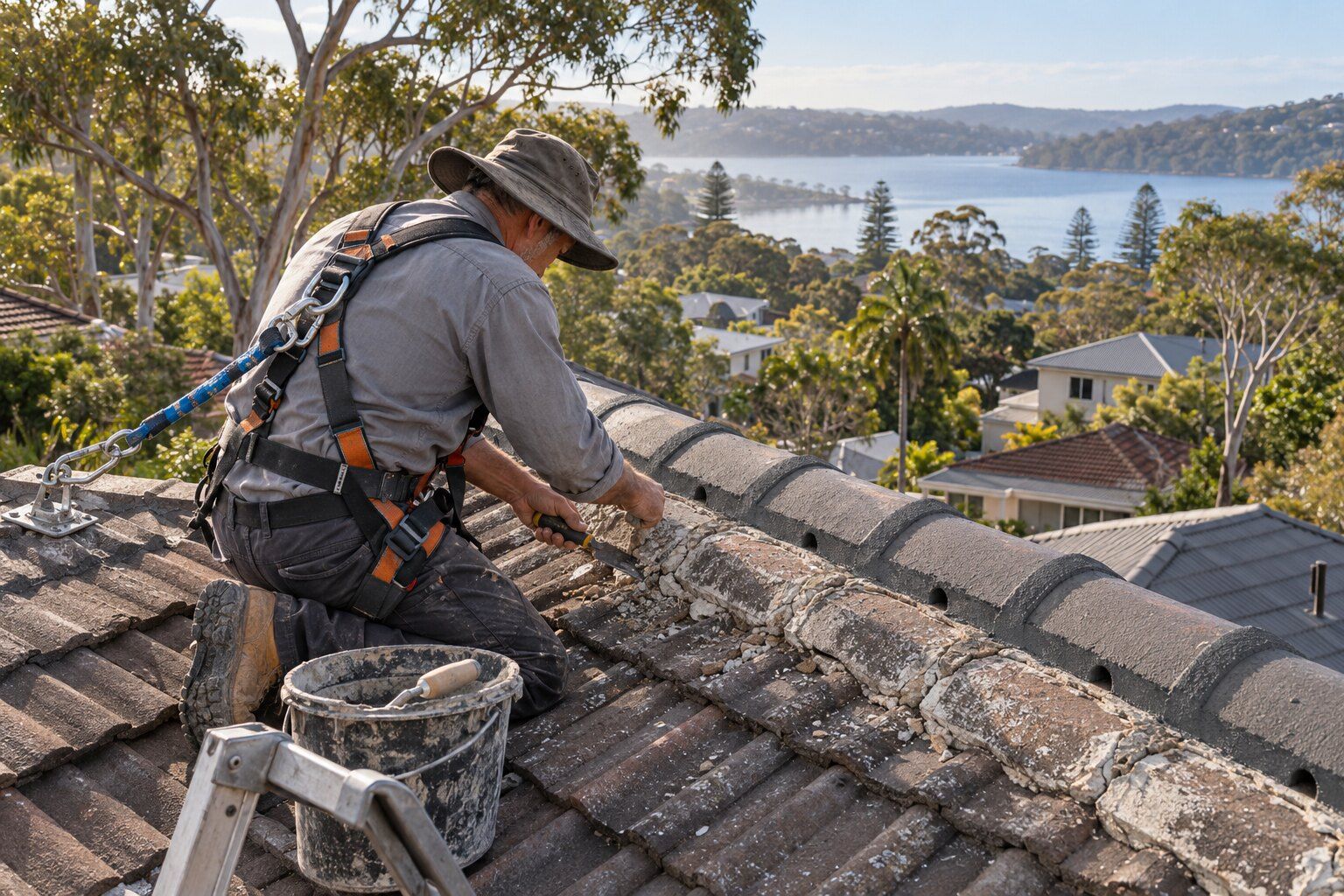
The short answer
Repointing replaces the thin top layer that seals the joint between the ridge or hip caps and the tiles below. Underneath it is the bedding, a mortar bed that holds the caps in place. When only the pointing has cracked, repointing over sound bedding is enough. When the bedding has broken up too, the caps have to come off and be rebedded first, then pointed. Published Sydney prices run from about $40 a metre for pointing to $1,500 to $4,000 for a full rebed and repoint, depending on the publisher.
What roof repointing is
A tile roof’s ridges (along the top) and hips (down the corners) are covered by rounded capping tiles. They sit on a bed of sand and cement mortar, and a coloured layer called pointing is pressed over the joint to seal it and hold the caps. A Sydney roofing contractor’s repointing page puts it simply: bedding is the “sand-cement mortar bed” and pointing is “the coloured flexible layer over the top”.
Repointing is replacing that top layer. Most roofers now use a flexible pointing compound rather than the hard cement pointing on older roofs. Monier, a roof tile manufacturer, says flexible pointing “is used to fix ridge capping, enhancing security in high winds.”
Repointing vs rebedding
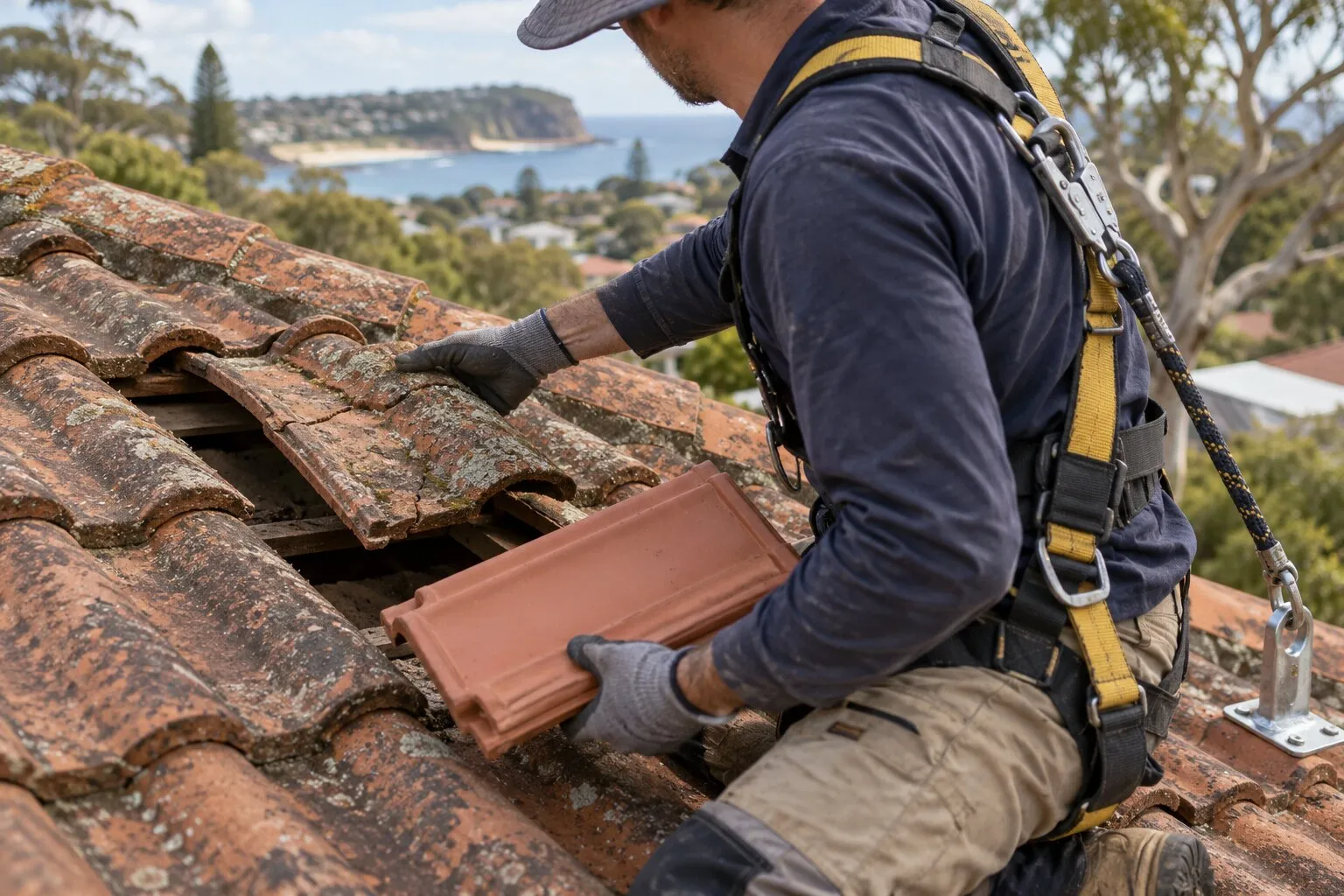
Repointing alone only works if the bedding underneath is sound. If the caps move when pushed or the mortar under them has crumbled, the roofer lifts the caps, lays a new mortar bed, re-sets them and then points over the top. That’s rebedding, and it costs more because it’s slower. Monier’s FAQ says that when ridge or hip capping mortar cracks or breaks, “Capping should be re-bedded or re-pointed”, and the roofer decides which once they’ve checked each cap.
Signs your ridge capping needs repointing
Northern Beaches roofs take wind-driven rain from southerlies and east coast lows, and that’s when failed pointing shows up as a leak near the top of the house. The Sydney contractor’s page lists these signs, and most can be checked from the ground or the roof space:
- “Mortar crumbs or coloured granules in the gutters after rain”
- “Visible cracks along the pointing lines”
- “Caps that move when pushed” (a roofer’s check, not yours: stay off the roof)
- Daylight or a draught at the ridge when you look up from inside the roof space
- A leak near the top of the roof that seems to move around
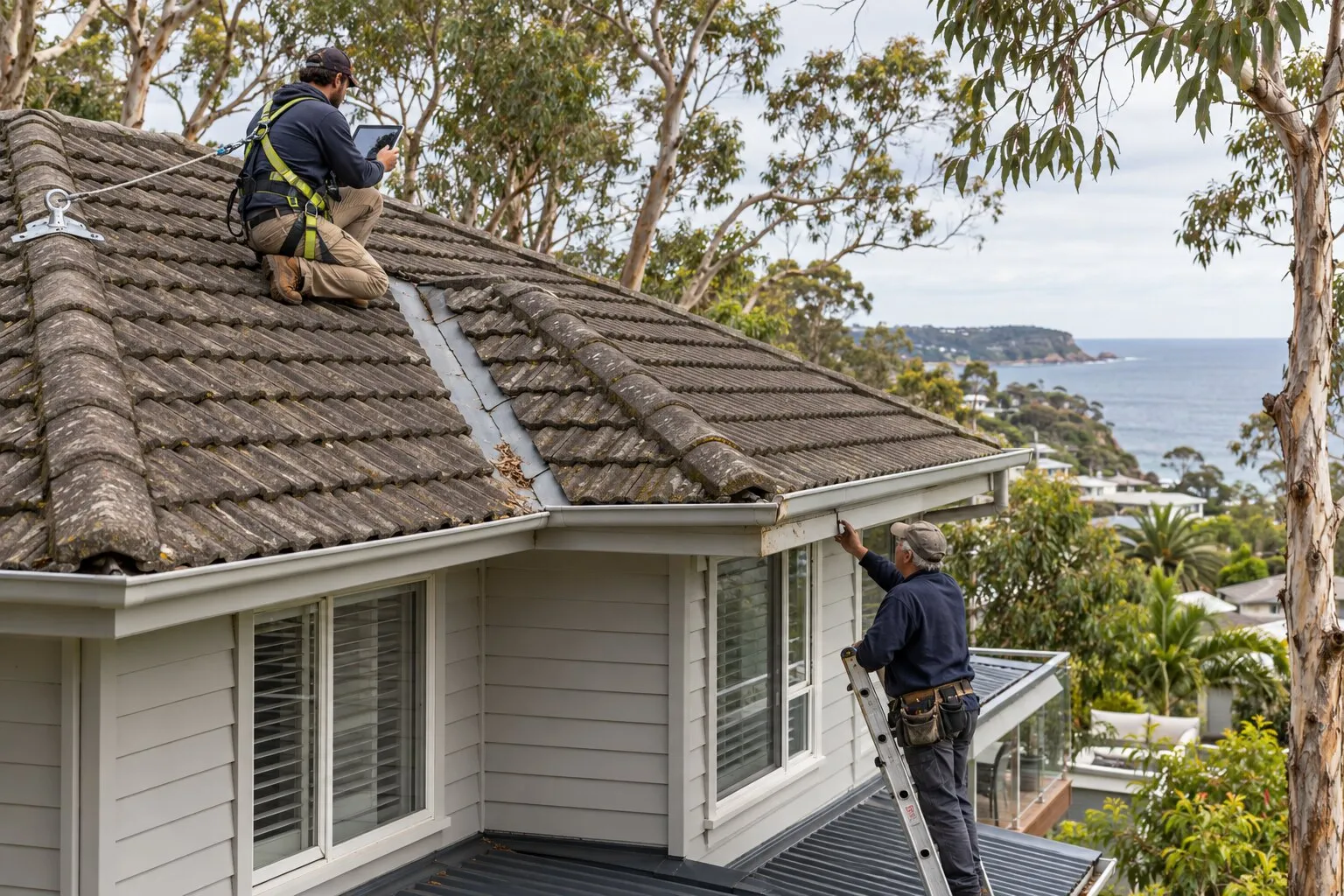
Use binoculars from the street or a neighbour’s yard rather than a ladder. SafeWork NSW’s code of practice for housing construction treats work with a risk of a fall of more than 2 metres as high-risk construction work, and a two-storey ridge above a steep Beaches block is well past that.
How a roofer repoints a ridge
On a typical job the roofer checks each cap, scrapes out loose and cracked pointing, rebeds any section where the bedding has failed, cleans the joint and then presses the new pointing on with a trowel, leaving weep holes so trapped water can drain.
Flexible pointing has its own rules. Selleys’ technical data sheet for its Point Works compound says the bedding should have “cured for at least 12 hours (15°C or higher)” first, that it must be “free of all holes and defects”, and not to use the product “if rain is likely within 2 hours”. It also says AS 2050, the tile installation standard, “requires all ridge and hip tiles to be fastened”, and that its compound qualifies as an adhesive mechanical fastener under the 2002 edition of that standard. Ask the roofer how the caps will be fixed on your roof.
Weather matters on the Beaches
Because pointing needs dry hours to cure, a good roofer won’t start a ridge with a southerly change or showers forecast. If the job is pushed back a day for rain, that’s the product’s instructions at work.
What roof repointing costs in Sydney
We found no Northern Beaches roofer that publishes a repointing price. These are Sydney contractors’ published figures, each shown with its publisher. A per-metre rate makes it easy to sanity-check a quote: measure the ridges and hips roughly from a plan or aerial photo and multiply.
Published ridge capping prices, per job and per metre
| What’s charged | Published price | Who publishes it |
|---|---|---|
| Full rebed and repoint, typical Sydney home | $1,500 to $4,000 | Aussie Roof Repairs, Sydney (undated) |
| Pointing ridge tiles, per lineal metre | $40 to $50 | North Shore Roof Repairs, Manly page (undated) |
Two Sydney contractors’ undated pages, checked 1 October 2026; neither says whether GST is included.
Published per-metre rates for repointing and rebedding
| What’s charged | Published price | Who publishes it |
|---|---|---|
| Ridge cap repointing, per linear metre | $40 to $60 | Innovate Roofing, Sydney rates (April 2025) |
| Ridge cap rebedding, per linear metre | $75 to $95 | Innovate Roofing, Sydney rates (April 2025) |
A Sydney contractor’s add-on rates, dated April 2025 and stated to include GST, checked 1 October 2026. They are about 18 months old, so treat them as a guide to what’s itemised rather than today’s price.
Expect the price to rise with a second storey, a steep pitch, scaffold, a long hip-and-valley roof and how much rebedding the caps need. More repair prices are in the roof repair cost guide.
How long repointing lasts
No standard or manufacturer we found gives a life span for pointing. The Sydney contractor whose prices are above says on its page that a proper rebed with flexible pointing “typically lasts 10 to 15 years”, and that pointing laid over failed bedding “often cracks within a year or two”. Those are one roofer’s figures, but they make the point: a cheap repoint over loose caps doesn’t last.
If the roof also has cracked tiles, moss or a faded coating, it can be cheaper to do the ridges as part of a restoration than to pay for access twice. Where tiles are crumbling across whole sections, ask about replacement instead.
Who can repoint a roof in NSW
NSW Fair Trading’s roof tiling licence covers tiles, tile bedding and pointing, flashing valleys, sarking and battens. A contractor licence is needed for work valued at more than $5,000 in labour and materials, including GST, and a written contract is needed over that amount. Check any roofer’s licence on the Service NSW licence register.
Common questions
What is roof repointing?
Repointing replaces the coloured sealing layer (the pointing) on the joint between the ridge or hip capping and the tiles. It sits on a mortar bed that holds the caps. If the bedding is still sound, only the pointing is redone; if not, the caps are rebedded first.
What’s the difference between rebedding and repointing?
Repointing redoes the top seal only. Rebedding lifts the ridge caps, lays a new mortar bed, re-sets the caps and then points them. Rebedding is needed when the caps are loose or the old bedding has crumbled, and it costs more.
How much does ridge capping repair cost?
A Sydney contractor publishes $1,500 to $4,000 for a full rebed and repoint on a typical Sydney home. Another’s Manly page prices ridge pointing at $40 to $50 per lineal metre. A third publishes $40 to $60 per metre for repointing and $75 to $95 for rebedding (April 2025, including GST). See the roof repair cost guide.
How often does a tile roof need repointing?
There’s no set interval. Monier recommends having the roof checked “Every five to seven years” by an expert tradesperson, and that’s a sensible time to look at the ridges. Mortar crumbs in the gutter or cracked pointing are the cue to call sooner.
Can I repoint my own roof?
We’d rather you didn’t. The work is on the ridge, the highest and most exposed part of the roof, and SafeWork NSW treats a fall risk of more than 2 metres as high-risk construction work. Over $5,000 the job also needs a licensed roofer.
Where this information comes from
The prices, rules and advice on this page come from these published pages, checked on 1 October 2026 (prices) and 12 October 2026 (product data and advice).
- Aussie Roof Repairs: roof repointing Sydney · Sydney roofing contractor (Oatley), undated
- North Shore Roof Repairs: Manly · Sydney roofing contractor (Ryde), Manly service-area page, undated
- Innovate Roofing: roof restoration cost Sydney · Sydney roofing contractor, cost guide dated April 2025, prices include GST
- Monier: FAQs · Roof tile manufacturer, page updated 22 September 2026
- Selleys Point Works GEN II: technical data sheet · Manufacturer technical data sheet, version 1.2, 10 November 2017
- SafeWork NSW: Code of Practice, managing the risk of falls in housing construction · NSW work health and safety regulator, approved code of practice, August 2019 edition
- NSW Government: roof tiling work licence · NSW Fair Trading licence page, updated 23 June 2026
- NSW Government: guide to providing home building contracts · NSW Fair Trading guidance, updated 11 June 2026
- Service NSW: check a trade licence · NSW Government licence register