The short answer
Make it safe first: keep away from a sagging ceiling and wet light fittings, and turn the power off at the switchboard if you can reach it without standing in water. Catch the water and move your things. If a storm damaged the roof, call the NSW SES on 132 500 (Triple Zero, 000, if life is at risk), take photos and contact your insurer early. Then a licensed roofer finds where the water gets in, usually starting inside the roof cavity, and fixes the cause. Don’t climb onto a wet roof.
1. Make it safe: power and ceilings
Two things in a leaking house can hurt someone: water near electrics, and a ceiling holding water. This is our advice for both.
- Water near a light, downlight or power point: don’t touch the fitting or switch. Turn the power off at the switchboard if you can get to it without standing in water, and have a licensed electrician check the circuit before it goes back on.
- A ceiling that’s sagging, bulging or cracking: keep everyone, pets included, out of the room. Wet plasterboard can give way without much warning, and it’s heavy. Don’t push on it or try to drain it yourself.
- Anyone hurt or in danger: call Triple Zero (000).
2. Catch the water and protect your things
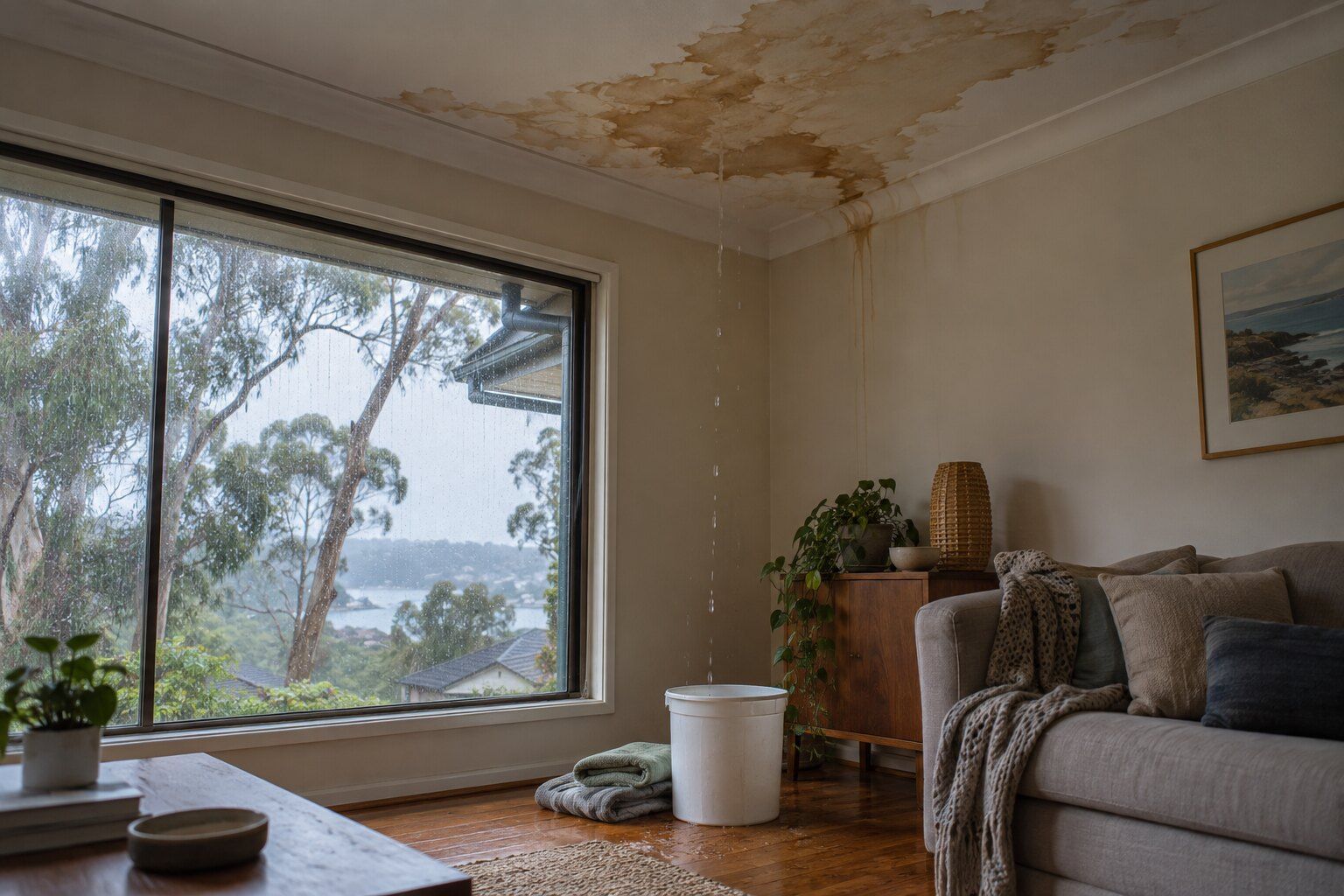
Once it’s safe to be in the room, put a bucket or tub under each drip, with an old towel in the bottom to stop splashing. Move furniture, rugs, electronics and anything precious out of the way, or cover what you can’t move with plastic sheeting. Mop up as you go so water doesn’t soak into floorboards or carpet. Empty the buckets before they’re full; a long night of rain fills them faster than you’d think.
Take photos now, before anything is cleaned up: the stain, the drips, the water on the floor and anything damaged. They help the roofer, and your insurer if it was a storm.
3. Who to call about a leaking roof
During the July 2025 east coast low, Northern Beaches Council’s advice was: “If you have any issues with flooding, roof damage or dangerous trees call SES on 132 500. In life-threatening situations call Triple Zero (000).” The NSW SES’s storm page says: “For emergency assistance during a flood, storm or tsunami, call NSW SES on 132 500. In a life-threatening emergency, call Triple Zero (000).”
Who to call about a leaking roof
| Situation | Who to call | Where this comes from |
|---|---|---|
| Someone is hurt or in danger | Triple Zero (000) | NSW SES; Northern Beaches Council |
| Storm or flood damage to the roof | NSW SES on 132 500 | NSW SES; Northern Beaches Council, July 2025 |
| Water near lights, power points or the switchboard | Power off at the switchboard if it’s safe to reach; a licensed electrician to check the circuit | Our advice |
| Property damaged in a storm | Your insurer, as soon as possible | NSW SES |
| A leak to find and fix | A licensed roofer: roof tiling for tiles, roof plumbing for metal, gutters and flashings | NSW Fair Trading licence categories |
Checked 1 October 2026. The row marked “Our advice” is ours, not an agency’s. The SES and council wording is quoted above.
For a leak that isn’t storm damage, or once the storm has passed, the person who finds and fixes it is a roofer. See roof leak repairs for how that works, or emergency roof repairs and storm damage if the roof was damaged in a storm.
4. How to find a roof leak, from inside
The leak is rarely right above the stain. Water gets in under a tile, sheet or flashing, then runs along the sarking, battens or rafters until it finds a low point to drip from. Finding the source starts in the roof cavity, and you can often narrow it down yourself before a roofer arrives.
The NSW SES says to “Stay safe when using a ladder by following the SafeWork NSW Pocket guide to ladder safety.” If you go up through the manhole, this is our advice:
- Only if you’re steady on a ladder, with someone at the bottom, and only in daylight with a good torch.
- Step only on the ceiling joists or a board laid across them. The plasterboard between them won’t hold you.
- Don’t touch wiring, and watch your head on nails and roofing screws coming through.
- Look above the stain first, then follow any wet or darkened timber, damp sarking or water marks uphill to where they start.
- Look for daylight through cracked or slipped tiles, and for rust or drips around screws on a metal roof.
- Photograph what you find and mark the spot with tape, so the roofer can go straight to it.
Stay off the roof
We’d rather you didn’t climb onto the roof to look, and never while it’s wet or storm-damaged. SafeWork NSW treats work with a risk of a fall of more than 2 metres as high-risk construction work, and warns that roofs containing asbestos “can be brittle, making them easy to fall through”. Look from the ground with binoculars, or from inside.
Why roofs leak: the common causes
A leaking roof usually comes back to one of these. A roofer checks them from inside and outside before fixing anything.
- Cracked, slipped or broken tiles, from age, foot traffic or falling branches. Without sarking underneath, water goes straight to the ceiling.
- Valleys full of leaves or rusted through, so water spills over the edge and under the tiles.
- Flashings lifted, cracked or corroded where the roof meets a chimney, skylight, vent pipe or wall.
- Ridge capping whose pointing has cracked and dropped out, letting wind-driven rain in along the ridge.
- Blocked gutters and downpipes. The NSW SES warns that “Blockages can trap water and cause it to overflow under the eaves into your roof cavity.”
- Metal roofs: loose or rusted screws, laps between sheets, and damaged sheets. The SES’s advice on preparing your home mentions “loose tiles, metal sheets and screws”.
- Storm damage: lifted tiles and sheets, or branches on the roof. In the storm of 26 March 2026, ABC News reported the SES Warringah Pittwater unit responding to more than 50 call-outs, with minor damage from tree limbs on roofs.
If the leak only appears in wind from one direction, or only in very heavy rain, tell the roofer: it can point to flashings, ridges or overflowing gutters rather than a broken tile.
Insurance: photos first, then call early
If the leak follows a storm, the NSW SES says: “If you experience damage to your property, contact your insurer as soon as possible to lodge a claim.” Our advice is to photograph everything before it’s moved, cleaned or repaired, note the date and time of the storm, and ask the roofer for photos of the damage they find on the roof. Whether a leak is covered, and what the insurer needs before repairs start, depend on your policy, so ask them rather than assume.
How a leaking roof gets fixed
There are two stages. A temporary fix keeps the water out while the roof is wet or the damage is fresh: a tarp, a temporary tile in a gap, or a sealant patch. It’s a stopgap, and sealant over a cracked tile or a rusted valley doesn’t fix the cause.
The permanent repair deals with the cause: matching tiles, a new valley, rebedded and repointed ridge capping, a new flashing, new screws or sheets, or cleared and repaired gutters. If the same roof keeps leaking in different places, ask the roofer whether a restoration or a new roof would cost less over time.
When a leaking roof needs a licensed roofer
NSW Fair Trading says you must hold a contractor licence to “carry out, advertise or contract for” building or trade work valued at more than $5,000 in labour and materials, including GST. Two licence categories cover most roof leaks:
- Roof tiling: tiles, tile bedding and pointing, flashing valleys, sarking and battens.
- Roof plumbing: metal roof coverings, guttering, downpipes and roof flashings.
Many leak repairs cost less than $5,000, but it’s still worth asking which licence the roofer holds. You can check it on the Service NSW licence register.
What a roof leak repair costs
We found no Northern Beaches roofer that publishes a price for leak repairs on their own. These published bands are the closest, each shown with its publisher. The roofer prices your repair once they’ve found the cause.
Published prices for leak-type repairs
| What’s charged | Published price | Who publishes it |
|---|---|---|
| Simple jobs: a few cracked tiles, a section of ridge, a flashing resealed | $300 to $800 | Crown Roofers, Mona Vale page (undated) |
| Larger scopes: multi-leak diagnosis, full ridge re-bed, storm damage across several sections | $1,500 to $3,500 | Crown Roofers, Mona Vale page (undated) |
| Minor storm repair: small leak, flashing, a few tiles or fixings | $300 to $1,000 | Cloud9 Roofing, Northern Beaches |
Quoted as each publisher states them, checked 1 October 2026; neither says whether GST is included. The first two rows are a Sydney-wide roofing contractor’s undated Mona Vale page, which uses the same wording as its pages for other suburbs. The last row is a Northern Beaches roofing contractor’s storm-damage page (published 30 April 2026), which calls its figures indicative. They’re per job, and the roofer prices yours once they’ve found the cause.
More repair and ridge capping prices are in the roof repair cost guide.
Common questions
What should I do first if my roof is leaking?
Make it safe. Keep everyone away from a sagging ceiling and from wet light fittings, and turn the power off at the switchboard if you can reach it without standing in water. Then put a bucket under the drip, move furniture and electronics, and take photos.
Who do I call when my roof is leaking?
In a life-threatening emergency, Triple Zero (000). For storm damage to the roof, the NSW SES on 132 500. For a leak that needs finding and fixing, a licensed roofer: roof tiling covers tile roofs, and roof plumbing covers metal roofs, gutters and flashings.
Is a leaking roof an emergency?
It can be. Water near electrics, a bulging ceiling or storm damage that has opened up the roof all need dealing with straight away: 000 if life is at risk, the SES on 132 500 for storm damage. A slow drip that a bucket can handle can usually wait for a roofer, though water left to get in keeps wetting the ceiling, insulation and timbers. See emergency roof repairs and storm damage.
How do I find where my roof is leaking?
From inside. With a torch, look in the roof cavity above the stain, then follow the wet marks on the timbers and sarking uphill to where they start, and look for daylight through the tiles. Water often travels a long way before it drips, so the source is rarely right above the stain. Stay on the ceiling joists, and stay off the roof itself.
Can I fix a leaking roof myself?
You can catch the water, protect your things and find roughly where it’s getting in. We’d rather you left the roof itself to a roofer: SafeWork NSW treats work with a risk of a fall of more than 2 metres as high-risk construction work, and a dab of sealant from a ladder rarely fixes the cause.
Will insurance cover my leaking roof?
That depends on your policy and what caused the leak, and only your insurer can tell you. After storm damage, the NSW SES says to “contact your insurer as soon as possible to lodge a claim”. Take photos before anything is moved or repaired.
How much does it cost to fix a roof leak?
A Sydney roofing contractor’s Mona Vale page publishes $300 to $800 for simple repairs and $1,500 to $3,500 for larger scopes such as diagnosing several leaks. A Northern Beaches roofing contractor separately publishes $300 to $1,000 for a minor storm repair, including a small leak. See roof repair cost.
Where this information comes from
The prices, rules and official advice on this page come from these published pages, checked on 1 October 2026.
- NSW SES: during a storm · NSW State Emergency Service guidance, undated
- NSW SES: prepare your home · NSW State Emergency Service guidance
- NSW SES: recovery · NSW State Emergency Service guidance, undated
- Northern Beaches Council: East Coast Low, get prepared · Local council news item, 2 July 2025
- SafeWork NSW: Code of Practice, managing the risk of falls in housing construction · NSW work health and safety regulator, approved code of practice, August 2019 edition
- SafeWork NSW: managing risks of exposure to asbestos · NSW work health and safety regulator, updated 30 June 2025
- NSW Government: roof tiling work licence · NSW Fair Trading licence page, updated 23 June 2026
- NSW Government: roof plumbing work licence · NSW Fair Trading licence page, updated 23 June 2026
- Service NSW: check a trade licence · NSW Government licence register
- Crown Roofers: roof repairs Mona Vale · Sydney-wide roofing contractor, Mona Vale suburb page, undated
- Cloud9 Roofing & Guttering: storm damage roof repair Northern Beaches · Northern Beaches roofing contractor (2099), published 30 April 2026
- ABC News: severe weather and storm calls across Sydney · News report, 26 March 2026